Back to Articles Image Of The Day

A Celestial Game of Peek-a-Boo: Moon Hides Venus in Daytime Sky

📖 3 min read 📊 beginner 🏷️ NASA APOD

In Brief

In a rare and captivating event, our Moon performed a celestial 'peek-a-boo' with the planet Venus. During daylight hours, the Moon passed directly in front of Venus, temporarily hiding it from view for observers in a small part of the world. Both celestial bodies appeared as beautiful crescents in the sky.
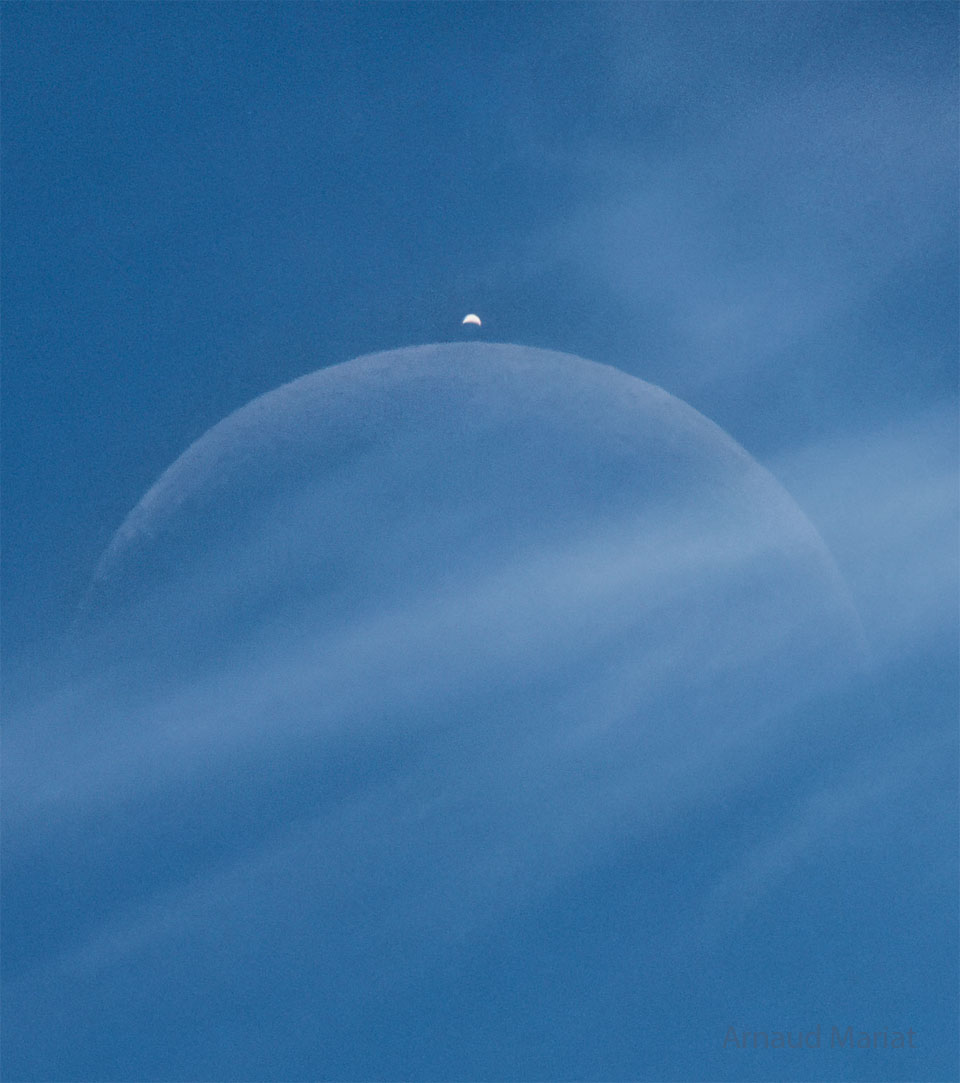
A Celestial Game of Peek-a-Boo: Moon Hides Venus in Daytime Sky

The Full Story

Imagine looking up at the sky in the middle of the day, with clouds somewhat obscuring your view. Suddenly, something truly extraordinary begins to unfold! That's what happened recently over the small village of Cessy, France, where our Moon played a cosmic game of hide-and-seek with the dazzling planet Venus. This rare event, known as an occultation, saw the Moon pass directly in front of Venus, briefly making the planet vanish from sight. What made this sighting even more fascinating was how both the Moon and Venus appeared. When observed closely, both were seen as delicate crescents, much like our Moon often appears in the night sky. The Moon itself was a slender sliver, with only about 10% of its surface illuminated by the Sun. Venus, though much farther away, showed a slightly fuller crescent, about 25% lit, giving us a beautiful, curved glimpse of its sunlit face. You might wonder why Venus, being so much farther away than our Moon, appeared brighter. The answer lies in two key factors: its proximity to the Sun and its highly reflective atmosphere. Venus orbits much closer to the Sun than Earth, bathing it in intense sunlight. More importantly, its thick, cloudy atmosphere acts like a giant, super-reflective mirror, bouncing a lot of that sunlight back towards us. Our Moon, in contrast, has a dark, rocky surface that absorbs much of the light, making it appear less brilliant. This celestial show was doubly remarkable because it happened during the daytime. While occultations of Venus by the Moon are already relatively rare – visible to only about 10% of Earth's surface – seeing one against a bright blue sky makes it even more challenging and unique. It's like trying to spot a faint star when stadium lights are on; the bright surroundings can easily overwhelm the subtle celestial phenomenon. Capturing such an event requires keen observation and often, specialized photographic techniques. Events like this Moon-Venus conjunction serve as powerful reminders of the constant, beautiful ballet happening far above our heads. They highlight the incredible precision of celestial mechanics and the unique perspectives we get from Earth. It's a chance to pause, look up, and feel a connection to the vast, dynamic universe we live in, inspiring us to learn more about the planets and moons that share our cosmic neighborhood.

Key Takeaways

  • 1 The Moon passed directly in front of Venus, a celestial event called an occultation.
  • 2 Both the Moon and Venus were observed displaying crescent phases.
  • 3 Venus appeared brighter than the Moon due to its reflective clouds and closer orbit to the Sun.
  • 4 This was a rare daytime event, visible only from a small portion of Earth.

💡 Think of it this way:

Imagine a friend walking across a room, briefly passing in front of a clock on the far wall. For a moment, the clock is hidden. That's essentially what happened in space, but with our Moon 'walking' in front of the much more distant planet Venus.

How We Know This

This incredible event was captured through careful observation and photography. Even with the challenge of daytime visibility and clouds, dedicated sky-watchers and astrophotographers used telescopes and cameras to zoom in and record the Moon's subtle passage in front of the brilliant planet Venus, revealing details like their crescent phases.

What This Means

Observing and documenting rare celestial alignments like this helps astronomers refine our understanding of orbital mechanics and the precise movements of objects in our solar system. More importantly, these events captivate the public, sparking curiosity about astronomy and encouraging more people to look up and appreciate the wonders of the night (and day!) sky. It reminds us that our universe is always putting on a show, if we only take the time to notice.

Why It Matters

This unique spectacle reminds us that our solar system is a dynamic playground, full of surprising and beautiful events, even during the day. It's a fantastic reminder to look up and appreciate the intricate dance of planets and moons above us, sparking wonder and curiosity about the cosmos.

Related Topics

#Astronomy #Occultation #Moon #Venus #Daytime Sky