Back to Articles Image Of The Day

Southern Sky's Dazzling Secret: A Nursery for Baby Stars & Ancient Giants

πŸ“– 3 min read πŸ“Š beginner 🏷️ NASA APOD

In Brief

Gaze into the Southern Crown constellation where two celestial wonders coexist: a vibrant, nearby cloud where new stars are being born, and a much older, incredibly distant cluster twinkling with stars as ancient as the universe itself. This cosmic snapshot reveals the vast timeline of stellar life in one view.
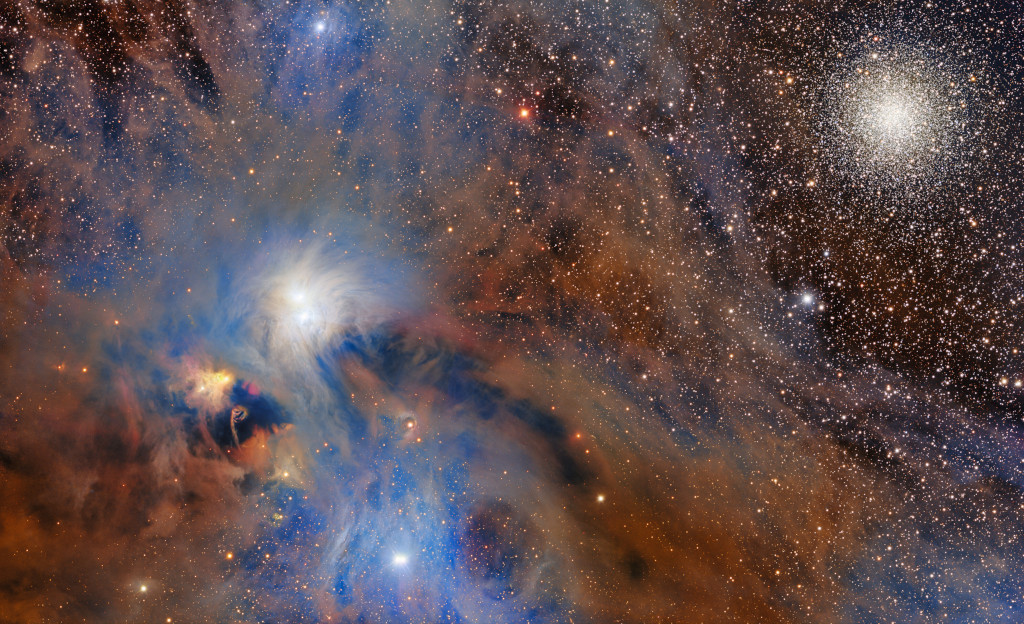
Southern Sky's Dazzling Secret: A Nursery for Baby Stars & Ancient Giants

The Full Story

Look up at the night sky towards the constellation Corona Australis, often called the Southern Crown, and you might glimpse what appears to be a dazzling cosmic neighborhood. However, this view is a masterful illusion. Today's incredible image brings together two vastly different celestial objects: a bustling nursery where new stars are just beginning their lives, and a serene, ancient cluster of stars that have been twinkling for nearly the entire age of the universe. They seem to share the same cosmic address, but in reality, they are separated by enormous distances and billions of years of history. On one side of this celestial pairing is the Corona Australis Molecular Cloud, a vibrant region just 430 light-years away – practically our cosmic next-door neighbor! This cloud is incredibly special because it's one of the closest places to Earth where stars are actively being born. Within its vast stretches, gas is so unbelievably cold, dipping to a frigid -260 degrees Celsius (-440 Fahrenheit), that it's dense enough to start collapsing under its own gravity. These collapsing pockets of gas are called protostars – essentially, stars in the making. As young, hot stars ignite within the cloud, their brilliant blue light illuminates the surrounding gas and dust, creating beautiful reflection and emission nebulae that paint the cloud in stunning hues. A fascinating binary star system, R Coronae Australis, even stirs up a nearby nebula, with its younger star energizing the gas with ultraviolet light, causing it to glow brightly like a cosmic lamp. Hanging gracefully in the upper right of the image is the Chandelier Cluster, officially known as NGC 6723. While it might look like it's part of the same star-forming party, don't be fooled! This cluster is tens of thousands of light-years farther away than the Corona Australis cloud, placing it at a truly immense distance from us. Unlike the bustling star nursery, the Chandelier Cluster is a venerable collection of stars, many of them almost as old as the universe itself. Imagine holding a family photo with great-great-grandparents next to a newborn! Interestingly, while primarily ancient, this cluster also experienced multiple bursts of star formation throughout its long history, leading to a population of stars with slightly varying ages, adding layers to its fascinating story. The apparent closeness of these two cosmic marvels is a fantastic trick of perspective. It’s like looking out a window and seeing a bird on a nearby branch and a mountain far in the distance – they look close in your field of view, but one is just feet away, and the other miles. In space, these differences are magnified by light-years! Observing them side-by-side allows astronomers to essentially 'time travel' in a single image, witnessing both the frantic birth of stars and the serene, long-lived existence of ancient stellar populations. By studying objects like the Corona Australis Molecular Cloud and the Chandelier Cluster, astronomers gain invaluable insights into the entire lifecycle of stars – from their violent birth in swirling gas clouds to their long, stable lives, and eventually, their graceful aging. These observations help us understand how star clusters form and evolve, how different generations of stars populate our galaxy, and ultimately, how the universe itself has unfolded over billions of years. Each new image from our powerful telescopes adds another piece to the grand puzzle of cosmic creation and evolution.

Key Takeaways

  • 1 The Southern Crown constellation features both a nearby, active star-forming region and a distant, ancient star cluster.
  • 2 The Corona Australis Molecular Cloud is one of the closest star nurseries to Earth, where new stars are being born from super-cold gas.
  • 3 The Chandelier Cluster (NGC 6723) is vastly farther away and contains stars nearly as old as the universe, showcasing stellar evolution over billions of years.
  • 4 Despite appearing close in our sky, these objects are separated by enormous distances, offering a 'time capsule' view of different cosmic eras.

πŸ’‘ Think of it this way:

Imagine looking at two houses on the same street. One is a busy construction site with new walls going up, full of energy and new life. The other is a grand, historic mansion, standing for centuries, its bricks whispering tales from long ago. They appear close, but represent entirely different chapters in time.

How We Know This

Astronomers use powerful telescopes, both on Earth and in space, to capture the faint light emitted by these distant cosmic objects. By analyzing the colors and intensity of this light, they can determine the composition, temperature, age, and motion of stars and gas clouds, piecing together their incredible stories.

What This Means

Continued observations of these diverse celestial environments will deepen our understanding of how stars and star clusters form, evolve, and interact within galaxies. This knowledge is crucial for building a complete picture of the universe's history and predicting its future, helping us understand our place within the grand cosmic tapestry.

Why It Matters

Understanding these celestial objects helps us unravel the mysteries of star birth, how stars evolve over billions of years, and ultimately, how our own solar system and galaxy came to be.

Related Topics

#Star Formation #Star Clusters #Nebulae #Corona Australis #Astronomy