Back to Articles Image Of The Day

Cosmic Sculptor: The Statue of Liberty Nebula's Secrets Unveiled

📖 3 min read 📊 beginner 🏷️ NASA APOD

In Brief

Gaze into the stunning Statue of Liberty Nebula, a cosmic wonderland where new stars are being born, massive stars are nearing their end, and complex molecules crucial for life are forming. This vibrant stellar nursery offers a breathtaking peek into the universe's most dramatic transformations.
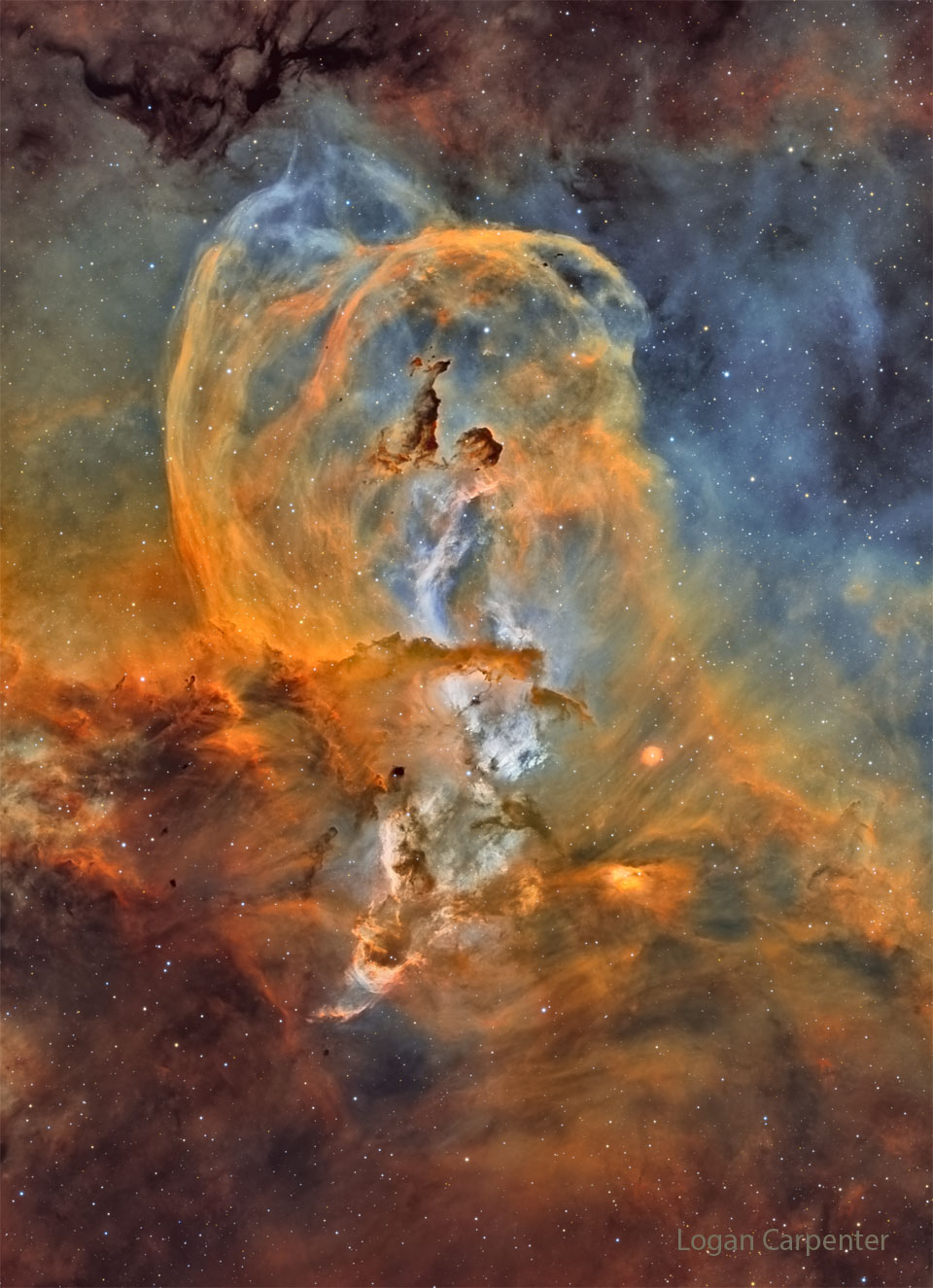
Cosmic Sculptor: The Statue of Liberty Nebula's Secrets Unveiled

The Full Story

High above us, nestled within the vast cosmic tapestry, lies a breathtaking celestial formation known as the Statue of Liberty Nebula (also cataloged as NGC 3576). More than just a pretty picture, this nebula, which to some even resembles a flying superhero or a weeping angel, is a bustling star-forming factory. It's part of an even larger star-making district called RCW 57, a dynamic region of space where the universe is constantly reinventing itself. In this magnificent 'cosmic nursery,' powerful forces are at play. Astronomers have identified at least 33 massive stars that are in the final stages of their birth, still gathering material before they fully ignite. You can see their influence in the vivid 're-assigned color' images, which highlight dense knots of dark interstellar dust – these are the raw materials from which stars are forged. Surrounding these stellar embryos are vast fields of glowing hydrogen gas, energized and set alight by the intense radiation from these bright, young stars, making the nebula shimmer with ethereal light. But it's not just about new beginnings here; the cycle of life and death plays out on a grand scale. The nebula also reveals great loops of gas that have been dramatically expelled by older, dying stars, enriching the surrounding space with new elements. Among these cosmic ingredients, scientists have made a particularly exciting discovery: the clear presence of polycyclic aromatic hydrocarbons (PAHs). You might think of PAHs as tiny, complex carbon molecules – a bit like the building blocks of soot you find on Earth, but in space, they're incredibly important. So, why are these PAHs such a big deal? They're thought to form in the cooling gas of star-forming regions, and their presence here offers a vital clue about our own beginnings. Scientists believe that PAHs, like those found in the Statue of Liberty Nebula, were present in the giant cloud of gas and dust that eventually formed our Sun and solar system five billion years ago. Their development then may have been a critical step in the complex chemical evolution that eventually led to the emergence of life on Earth. Finding them elsewhere provides compelling evidence that the ingredients for life might be widespread in the universe. This stunning view and these intricate discoveries are thanks to advanced astronomical observations and detailed studies. By capturing and analyzing light from this distant nebula, often through sophisticated 're-assigned color' imaging that helps reveal different elements and processes, astronomers can peer through vast cosmic distances. They essentially 'read' the light, identifying the chemical signatures and physical conditions within the nebula, allowing them to map out star formation, stellar death, and the distribution of crucial molecules like PAHs. The Statue of Liberty Nebula continues to be a vibrant laboratory for understanding the universe's grand cycles. By studying nebulae like NGC 3576, we not only gain insight into how stars and planets form, but also how the very chemical precursors for life itself are forged and distributed across the cosmos. Every new detail we uncover helps us piece together the ultimate cosmic puzzle: how we came to be, and whether the seeds of life are sprouting in countless other corners of the galaxy.

Key Takeaways

  • 1 The Statue of Liberty Nebula (NGC 3576) is an active star-forming region, home to newly forming massive stars and dying older ones.
  • 2 It showcases dense dust clouds where stars are born and glowing hydrogen gas energized by young stars.
  • 3 Astronomers discovered complex carbon molecules called Polycyclic Aromatic Hydrocarbons (PAHs) within the nebula.
  • 4 PAHs are considered vital building blocks for life, potentially crucial for the chemical evolution that led to life on Earth.
  • 5 Advanced imaging and detailed studies of light from the nebula allow scientists to map out cosmic processes and chemical compositions.

💡 Think of it this way:

Imagine a giant galactic kitchen where ingredients for stars and even life are being cooked up, some of it shaped like a famous monument or a soaring superhero!

How We Know This

Astronomers use powerful telescopes to capture and analyze light from the Statue of Liberty Nebula. Through detailed studies and sophisticated imaging techniques, often using 're-assigned colors' to highlight specific elements and processes, they can identify the types of gases, dust, and molecules present, as well as the stages of star formation and death occurring within the nebula. This 'reading' of light allows them to uncover the nebula's secrets.

What This Means

This discovery provides strong evidence that the fundamental chemical building blocks for life are produced in common star-forming regions throughout the universe. It strengthens the hypothesis that life's origins on Earth might be part of a universal cosmic process, potentially increasing the likelihood of finding life, or its precursors, on other planets. Continued study of such nebulae will deepen our understanding of star and planet formation and the chemical pathways to life.

Why It Matters

The discovery of specific carbon molecules (PAHs) in this nebula suggests how the building blocks of life, like those on Earth, might arise in star-forming regions across the galaxy. It helps us understand our own cosmic origins and the potential for life elsewhere.

Related Topics

#Star Formation #Nebula #PAH #Origin of Life #Astrophysics