Back to Articles Image Of The Day

Stunning Photo: Mountain Shadow Points to a Rainbow's Heart!

📖 3 min read 📊 beginner 🏷️ NASA APOD

In Brief

A breathtaking photo captured a perfect alignment where a mountain's long shadow seemed to point directly to the center of a vibrant rainbow at sunset. This stunning natural phenomenon, photographed from a fire lookout, beautifully illustrates how perspective and light play tricks on our eyes and the atmosphere.
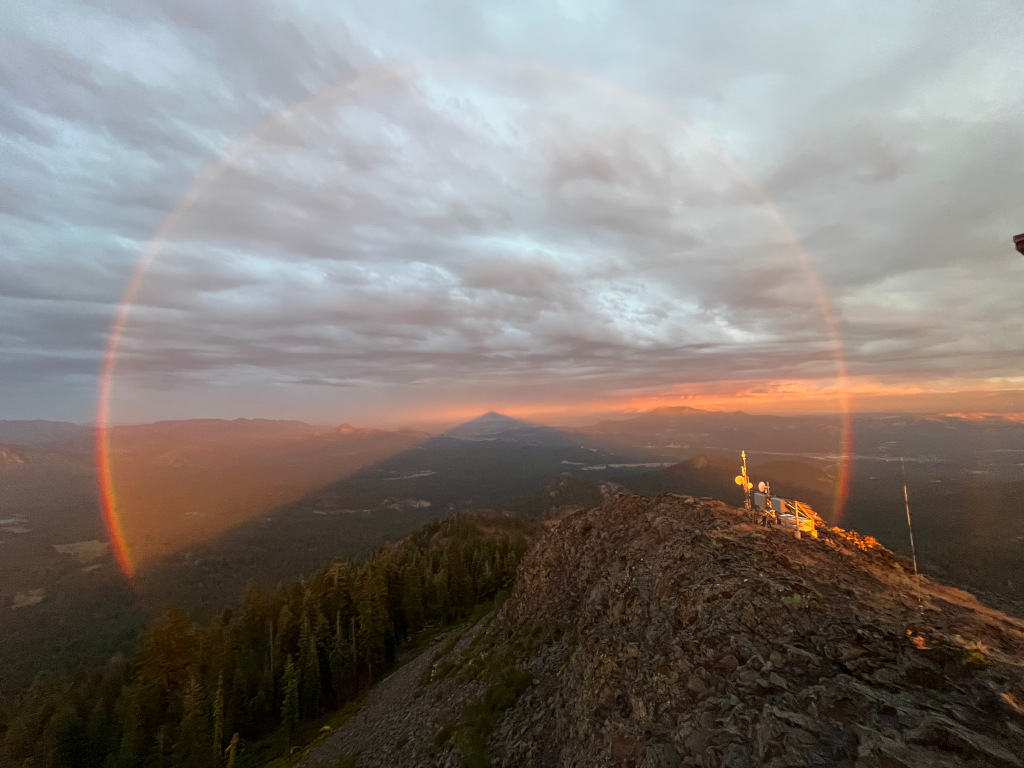
Stunning Photo: Mountain Shadow Points to a Rainbow's Heart!

The Full Story

From a fire lookout on Smith Peak in California, a photographer recently captured a truly magical moment where a towering mountain's shadow appeared to perfectly bisect a vibrant rainbow at sunset. This wasn't just a lucky shot; it was a spectacular display of celestial geometry playing out in our own atmosphere. The scene, bathed in the warm glow of the 'golden hour,' showcases how our unique vantage point on Earth allows us to witness such captivating alignments. The secret to the mountain shadow's seemingly precise aim lies in perspective and a concept known as the 'antisolar point.' Due to the immense distance and the long line of sight, the mountain's shadow, stretching out across the landscape, naturally tapers into a triangular shape. The very tip, or apex, of this shadow isn't random; it's always positioned at the point directly opposite the Sun on the horizon. Think of it like an arrow shot straight through the Earth from the Sun – the shadow's tip lands on the opposite side. Now, let's talk about the rainbow. These arcs of color light up the sky after rain, created when sunlight enters countless tiny water droplets. The light bends, reflects off the back of the droplet, and then bends again as it exits, splitting into its component colors. This specific dance of light and water droplets means that a rainbow always appears at a characteristic 42-degree angle relative to the observer's line of sight to the antisolar point. This is why every rainbow has that familiar arc shape. What makes this photograph so extraordinary is the flawless alignment. The geometric center of any rainbow arc also lies precisely at the antisolar point. So, on this particular evening, following some thunderstorms, the setting Sun created both a long mountain shadow and a brilliant rainbow. And because both phenomena share that common geometric anchor – the antisolar point, which was opposite the setting Sun – the shadow naturally appeared to point right to the heart of the rainbow. It's a beautiful cosmic coincidence driven by fundamental physics. This incredible snapshot is a vivid reminder that some of the most profound and beautiful scientific principles are at play in the everyday world around us. It shows how light, water, and our planet's position relative to the Sun can conspire to create fleeting moments of breathtaking beauty. Understanding the science behind these sights doesn't diminish their wonder; it only deepens our appreciation for the intricate dance of nature.

Key Takeaways

  • 1 Mountain shadows naturally point opposite the Sun due to perspective.
  • 2 Rainbows are formed by sunlight refracting and reflecting within water droplets.
  • 3 Both the shadow's 'tip' and the rainbow's center are located at the 'antisolar point', which is directly opposite the Sun.
  • 4 This unique alignment captured in the photo is a perfect example of atmospheric optics and geometry at play.

💡 Think of it this way:

Imagine looking down a very long, straight road – the two sides appear to meet at a single point far in the distance, even though they are parallel. Our vision and perspective create that illusion, much like how the mountain's shadow seems to converge at a single point.

How We Know This

This stunning image was captured by a photographer from a fire lookout on Smith Peak in California. While no special technology beyond a camera was needed, the unique elevated vantage point offered by the lookout, combined with perfect timing during sunset after regional thunderstorms, allowed for this remarkable alignment to be observed and documented.

What This Means

While not a scientific 'discovery' in the traditional sense, understanding these natural phenomena enhances our appreciation for the world around us. It encourages us to observe our environment more closely, recognize the beautiful physics constantly at play, and inspires curiosity in science and nature. It serves as a powerful visual aid for explaining concepts like perspective, light refraction, and geometric centers in an engaging way.

Why It Matters

This captivating image reminds us of the hidden artistry in everyday natural events and how basic physics shapes the spectacular views we sometimes take for granted. It encourages us to look closer at the world around us and appreciate the science behind its beauty.

Related Topics

#Atmospheric Optics #Rainbow #Mountain Shadow #Sunset #Perspective #Antisolar Point