Back to Articles Image Of The Day

NGC 300: A Nearby Galaxy's Hidden, Colorful Glow

πŸ“– 3 min read πŸ“Š beginner 🏷️ NASA APOD

In Brief

Astronomers have captured a stunning new portrait of NGC 300, one of our closest spiral galaxy neighbors, revealing not just its stars but also vibrant, glowing clouds of gas. This unique image acts like an X-ray, highlighting hidden energetic processes within the galaxy driven by massive, young stars.
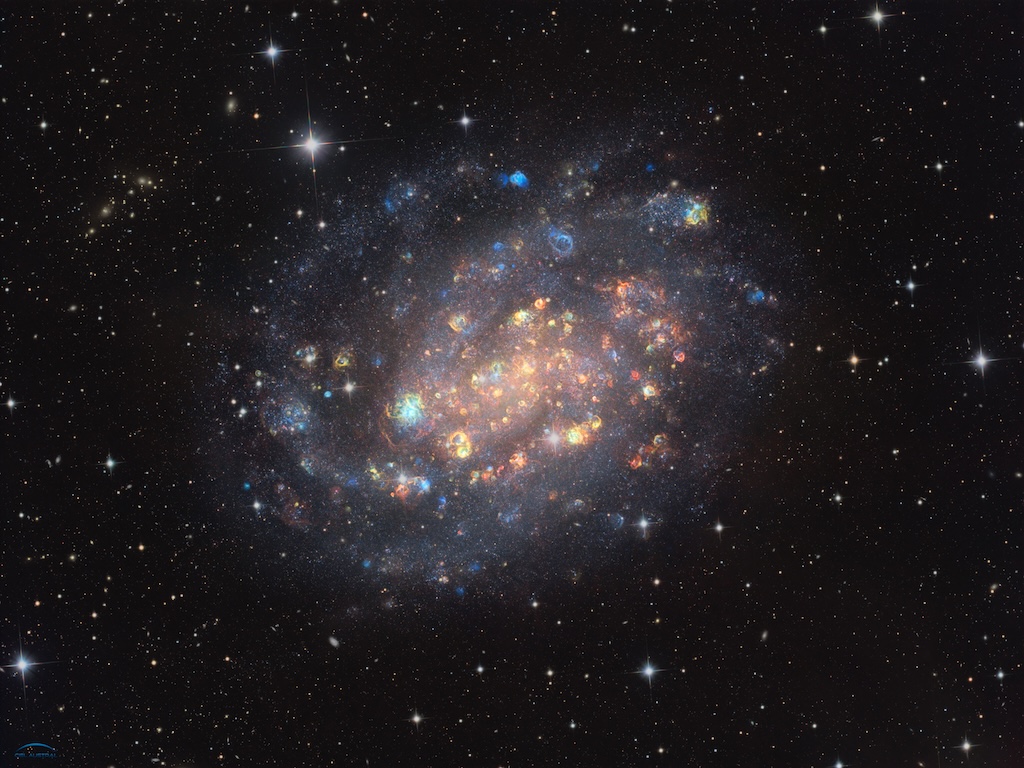
NGC 300: A Nearby Galaxy's Hidden, Colorful Glow

The Full Story

Peering into the vast cosmic ocean, astronomers have unveiled a breathtaking new view of NGC 300, a majestic spiral galaxy that’s practically our galactic next-door neighbor, a mere 6 million light-years away. While we often see galaxies as shimmering collections of stars, this particular image offers something truly special – it's less like a simple photograph and more like a vibrant, living portrait, showcasing the galaxy's hidden energy and activity. What makes this portrait so unique is its ability to highlight not just the countless stars and dust lanes, but also vast, glowing clouds of interstellar gas. Think of it like a cosmic forensics photo: instead of just seeing the surface, we're detecting specific chemical fingerprints. Special filters on telescopes have allowed scientists to capture the distinct light emitted by ionized sulfur (glowing red), hydrogen (glowing green), and oxygen (glowing blue). When combined, these colors create a dazzling display, especially yellows and oranges, making NGC 300 glow like a spectacular celestial neon sign. But why are these gases glowing? The answer lies with the galaxy's most energetic residents: young, massive stars. These stellar giants are incredibly hot and powerful, churning out intense ultraviolet radiation – light so energetic it can strip electrons from gas atoms, a process called ionization. This is similar to how a neon sign works, where electricity energizes gas to make it glow. These massive stars, however, live fast and die young, burning through their fuel in a cosmic blink of an eye compared to our Sun. When they reach the end of their lives, they explode in spectacular supernovas, leaving behind dramatic cosmic debris. Some of the fiery clouds we see in this image could very well be the remnants of these colossal stellar explosions. This multicolored view isn't just pretty; it's a goldmine of scientific information. By mapping these glowing gas clouds, astronomers can trace regions of intense star formation, locate where new stars are being born, and study the intricate processes that fuel a galaxy's evolution. It helps us understand how elements are recycled within a galaxy and how the violent deaths of massive stars can enrich the surrounding space with heavy elements, eventually forming new generations of stars, planets, and even the building blocks of life. The ability to see these specific elemental glows offers an unprecedented look into the dynamic 'inner workings' of a spiral galaxy. Future observations will continue to refine our understanding of star birth and death cycles in NGC 300, potentially revealing more supernova remnants and giving us a clearer picture of how galaxies grow and transform over cosmic timescales. It’s like having a cosmic weather map, showing us where the storms of star formation are raging and where the quiet aftermath of stellar explosions is unfolding.

Key Takeaways

  • 1 NGC 300 is a nearby spiral galaxy, only 6 million light-years away.
  • 2 The image uniquely combines starlight with the distinct glow of ionized gases (Sulfur, Hydrogen, Oxygen).
  • 3 Massive, young stars act as cosmic 'flashlights,' ionizing the surrounding gas and making it glow.
  • 4 This reveals active star-forming regions and potential supernova remnants within the galaxy.
  • 5 The study helps us understand galaxy evolution, star life cycles, and the distribution of elements in the universe.

πŸ’‘ Think of it this way:

Imagine a city at night: you see the individual lights of houses and cars (the stars), but this image is like seeing the entire electrical grid glowing, revealing where all the power is being generated and used throughout the city.

How We Know This

To create this detailed image, astronomers use powerful telescopes equipped with specialized filters. These filters allow only very specific wavelengths of light to pass through – much like using colored glasses to see only certain colors. By combining images taken through filters sensitive to the light emitted by ionized sulfur, hydrogen, and oxygen, scientists can reconstruct a vivid portrait that highlights these glowing gas clouds, revealing details invisible in standard broadband images.

What This Means

This unique perspective on NGC 300 provides crucial clues about the life cycle of stars and the chemical evolution of galaxies. It helps astronomers identify potential sites of recent supernova explosions and understand how these cosmic events enrich the interstellar medium with new elements. Ultimately, it allows us to build a more complete picture of how galaxies like our own Milky Way formed, evolved, and continue to create the raw materials for future solar systems.

Why It Matters

Understanding galaxies like NGC 300 helps us piece together the universe's grand story, from how stars are born and die to how galaxies evolve and create the very elements that make up planets and life. It's a direct window into the dynamic processes shaping our cosmic neighborhood.

Related Topics

#NGC300 #Spiral Galaxy #Star Formation #Cosmic Gas #Supernovae