Back to Articles Image Of The Day

Cosmic Fireworks: 'Red Sprites' Sparkle Above a Colombian Desert

📖 4 min read 📊 beginner 🏷️ NASA APOD

In Brief

High above Colombia's Tatacoa Desert, a rare and spectacular event unfolded: 'red sprites' — giant, fleeting bursts of reddish light stretching skyward. These ethereal flashes are a unique form of atmospheric electricity, far more exotic than your everyday lightning and are often triggered by powerful thunderstorms.
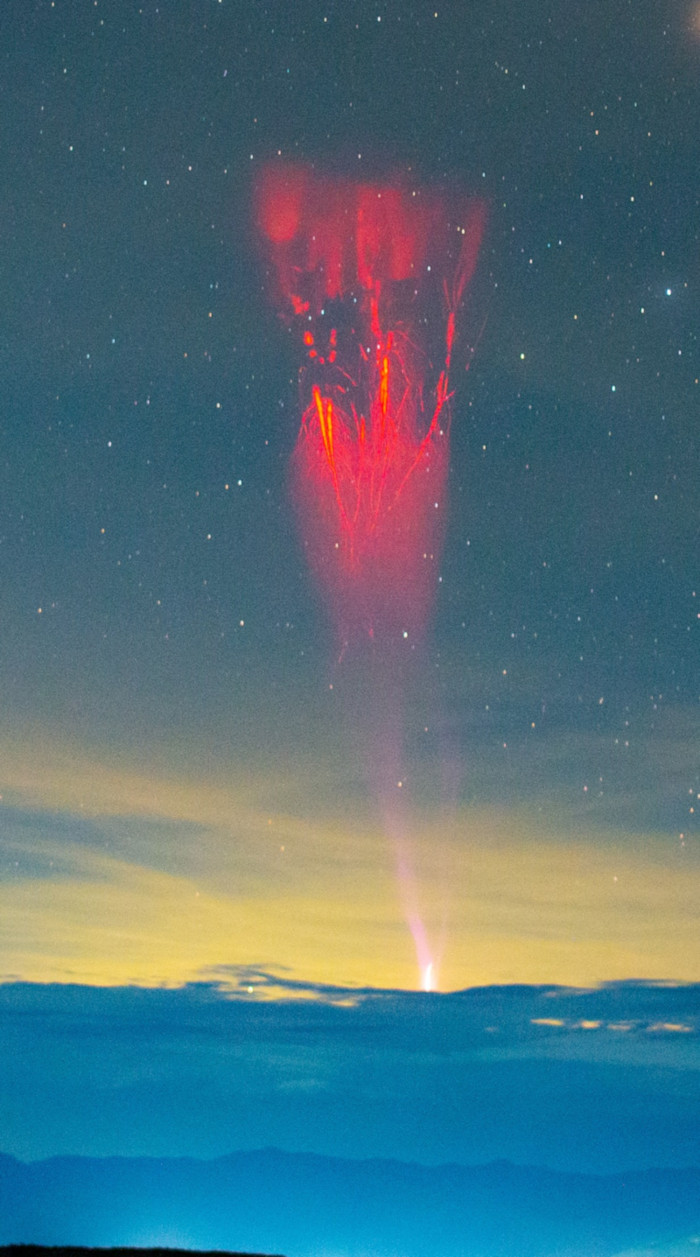
Cosmic Fireworks: 'Red Sprites' Sparkle Above a Colombian Desert

The Full Story

Deep in the Tatacoa Desert of Colombia, the night sky recently offered a breathtaking spectacle usually reserved for science fiction movies. What appeared to be a surge of crimson energy, stretching upwards from a distant storm, was in fact a 'red sprite' – a mysterious and powerful electrical phenomenon occurring high above typical thunderclouds. This stunning capture highlights a world of atmospheric physics we're still just beginning to understand, far beyond the familiar crackle and flash of a lightning bolt. To appreciate a red sprite, let's first quickly recall how regular lightning works. When ice particles and water droplets in thunderclouds rub against each other, they build up an electrical charge – usually negative at the bottom of the cloud and positive at the top. When this charge imbalance becomes too great, the air can no longer act as an insulator, and *zap!* – electricity rips through the sky, superheating the air into a bright white strike of plasma, that's the lightning we all know. This lightning usually travels between clouds, or from cloud to the ground. Red sprites, however, are a different beast entirely. They are not lightning themselves, but rather a *reaction* to a very specific type of powerful lightning strike: a positive cloud-to-ground lightning bolt. While regular lightning often transfers negative charge to the ground, positive cloud-to-ground strikes send a massive surge of positive charge to the Earth. This sudden jolt creates an electric field above the thundercloud, reaching far up into the mesosphere – a layer of Earth's atmosphere so high that the air is too thin for thunder to form. In this thin, upper atmosphere, the electrical energy excites nitrogen molecules, causing them to glow with a distinctive reddish hue, much like how neon lights work. These sprites are incredibly fast, lasting only milliseconds, and often appear as multiple 'streamers' reaching upwards like tentacles, or sometimes as a more diffuse column of light. One theory suggests that the powerful positive lightning temporarily exposes the negatively charged core of the thundercloud to the positively charged upper atmosphere, allowing a quick, giant connection to form. The discovery of these fleeting phenomena has significant implications beyond just spectacular photos. Studying red sprites helps scientists better understand the intricate electrical dynamics of Earth's atmosphere, especially the mesosphere, which is a less-explored region vital for understanding weather patterns and space weather interactions. What's more, these aren't just an Earthly phenomenon: NASA's Juno spacecraft has observed similar sprites on Jupiter, indicating that these powerful atmospheric phenomena are universal, potentially offering insights into the atmospheric conditions and electrical activity on distant worlds. As our understanding grows, events like these in the Tatacoa Desert remind us of the dynamic, often unseen, electrical ballet happening constantly above our heads. They highlight how much there is still to learn about our own planet's atmosphere and how that knowledge can extend to the furthest reaches of our solar system, deepening our appreciation for the cosmos.

Key Takeaways

  • 1 Red sprites are giant, fleeting electrical discharges that appear high above thunderclouds, not ordinary lightning.
  • 2 They are triggered by powerful positive cloud-to-ground lightning, which is a rarer type of lightning strike.
  • 3 Sprites extend into the mesosphere (upper atmosphere) and glow red due to excited nitrogen molecules.
  • 4 These phenomena are not unique to Earth; NASA's Juno spacecraft has observed similar sprites on Jupiter.
  • 5 Studying red sprites helps us understand Earth's atmospheric electricity and planetary science across the solar system.

💡 Think of it this way:

Imagine a quick, reddish 'short circuit' connecting the top of a thundercloud to the edge of space, appearing almost like an angry cosmic light show, but lasting only a blink of an eye.

How We Know This

This stunning image captures a red sprite event high above the Tatacoa Desert in Colombia. Such fleeting phenomena are typically observed by specialized high-speed cameras or low-light sensitive cameras from ground stations, often positioned in dark locations to look upwards above intense thunderstorms. Sometimes, they are also captured from aircraft or even the International Space Station, allowing scientists to study their characteristics and frequency.

What This Means

Continued research into red sprites could refine our models of planetary atmospheres and improve our understanding of 'space weather,' which can affect satellites and communication systems. By studying these powerful events on Earth and other planets like Jupiter, scientists gain valuable insights into fundamental atmospheric physics, helping us build a more complete picture of how planets form and evolve.

Why It Matters

Understanding red sprites helps us unravel the complex electrical dance happening in Earth's upper atmosphere and even gives us clues about similar powerful phenomena on other planets like Jupiter, impacting our knowledge of planetary science and space weather.

Related Topics

#Red Sprites #Atmospheric Phenomena #Lightning #Jupiter #Mesosphere