Cosmic Peanut Reveal: Hayabusa2 Finds Asteroid Torifune is a Double!
In Brief
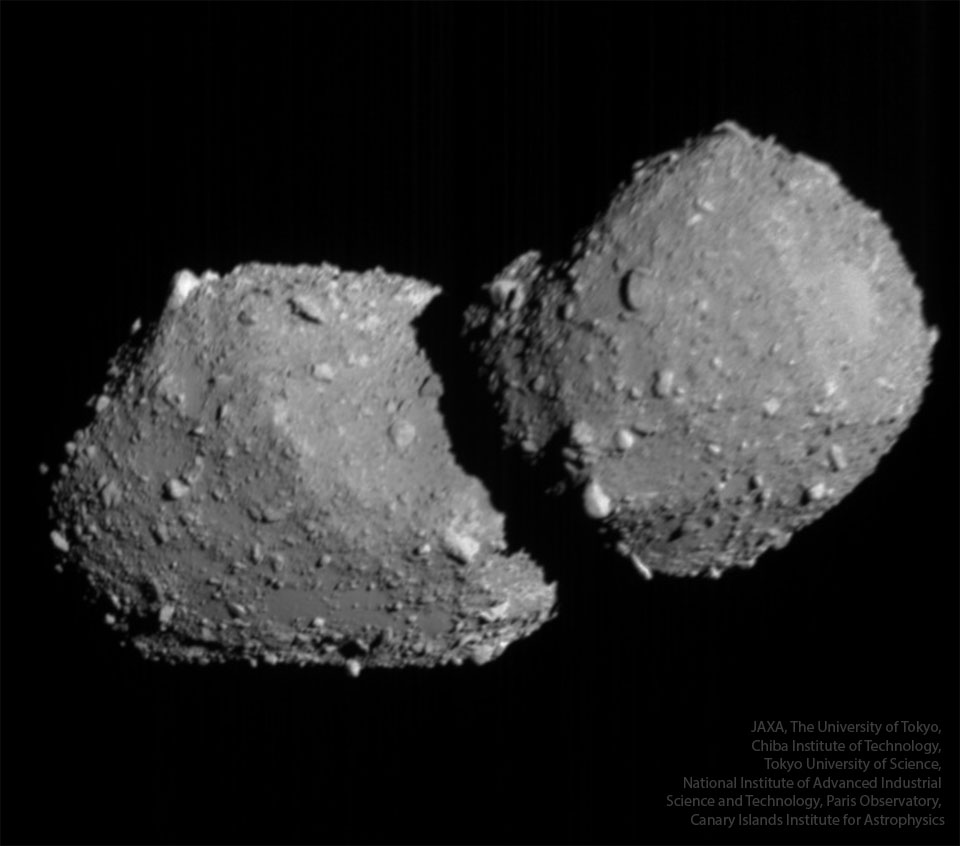
Japan's Hayabusa2 spacecraft just flew past asteroid Torifune, revealing it's not a single oblong rock but two large space bodies gently stuck together, like a cosmic peanut. This close-up look is helping scientists understand how these ancient space rocks form and evolve in our solar system.
The Full Story
Key Takeaways
- 1 Asteroid Torifune is a 'contact binary,' meaning it's made of two separate lobes gently joined together, like a cosmic peanut.
- 2 Despite its size (four soccer fields long), Torifune is a 'rubble pile' asteroid with surprisingly few craters, indicating a loose composition.
- 3 This discovery, made by the Hayabusa2 spacecraft, helps scientists understand how asteroids form and provides insights into the early solar system.
💡 Think of it this way:
Imagine two giant, irregularly shaped potatoes that softly bumped into each other in space and gently stuck together to form one larger object – that's essentially what asteroid Torifune looks like!
How We Know This
The discovery was made possible by the Japanese Hayabusa2 spacecraft, which conducted a close flyby of asteroid Torifune. Using its advanced cameras, the probe captured high-resolution images that revealed details far beyond what could be seen from Earth-based telescopes. This close-range observation was crucial to uncovering Torifune's true, double-lobed nature.
What This Means
This finding significantly enhances our understanding of 'contact binary' asteroids and 'rubble pile' formations, offering direct evidence for theories about how small bodies in the early solar system coalesced. It provides valuable data for models of planet formation and for developing strategies for future asteroid missions, including those that might explore or even mine these objects for resources. Furthermore, the continued success of missions like Hayabusa2 demonstrates humanity's growing capability to explore and understand the vastness of our cosmic neighborhood.
Why It Matters
Understanding these 'rubble pile' asteroids gives us crucial clues about the chaotic beginnings of our solar system and how planets formed. It also helps us refine strategies for future space missions, whether for planetary defense or even potential asteroid resource utilization.