Back to Articles Image Of The Day

Peek-a-Boo Moon: Catching Our Hidden 'Eastern Sea' on the Western Edge!

πŸ“– 3 min read πŸ“Š beginner 🏷️ NASA APOD

In Brief

Astronomers recently captured a rare, clear view of the Mare Orientale, or 'Eastern Sea,' one of the Moon's most dramatic impact basins. Despite its name, this enormous, young crater appears along the Moon's western edge due to an old mapping convention. This fleeting glimpse was made possible by a favorable lunar 'wobble.'
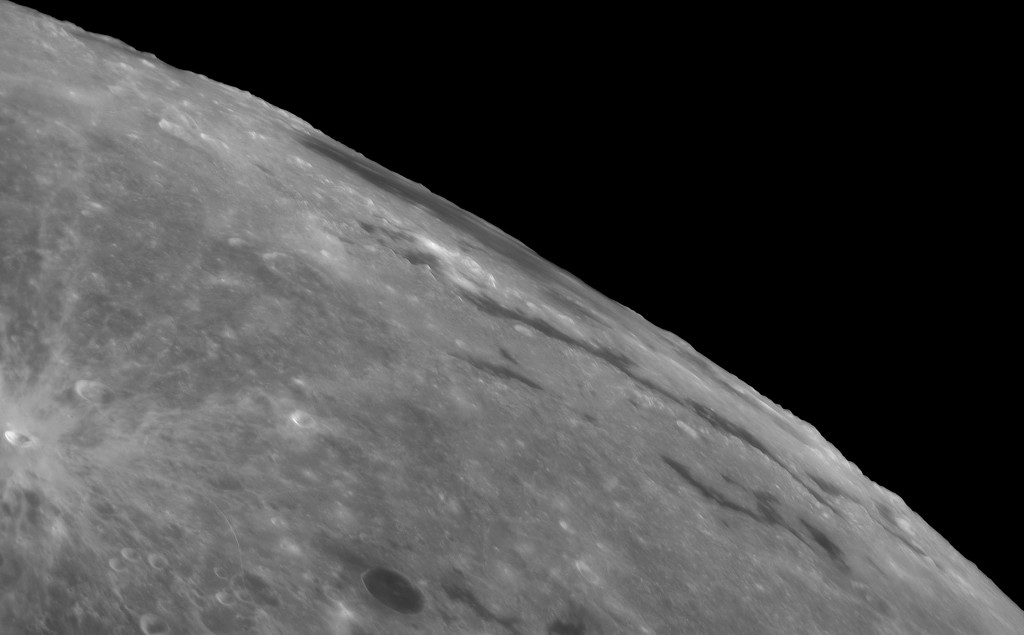
Peek-a-Boo Moon: Catching Our Hidden 'Eastern Sea' on the Western Edge!

The Full Story

Our Moon often presents us with familiar faces, but sometimes, it gives us a rare glimpse of its hidden wonders. Recently, astronomers managed to capture a stunningly sharp image of the Mare Orientale – Latin for 'Eastern Sea' – one of the most magnificent and dramatic features on the lunar surface. What makes this sighting so special is that this giant impact basin is incredibly difficult to spot from Earth, usually hugging the very edge of the Moon's visible face, almost out of sight. The Mare Orientale isn't just any crater; it's the youngest and one of the largest major impact basins on the Moon, stretching nearly 1,000 kilometers (about 620 miles) across. Formed over 3 billion years ago when a massive asteroid slammed into our celestial neighbor, its most striking features are the concentric rings that ripple outwards from the center, much like the rings you'd see if you dropped a stone into a pond. These 'ripples' are actually giant fault scarps and mountain ranges, evidence of the immense forces that reshaped the lunar crust. So, how did we get such a clear view of something usually so shy? The Moon isn't perfectly stable in its orbit; it actually 'wobbles' or tilts slightly as it goes around Earth. This phenomenon is called 'libration,' and sometimes, just like tilting your head to see around a corner, the Moon’s tilt gives us a brief peek at parts of its far side or extreme edges. This particular image, taken on July 7th, benefited from a period of 'favorable libration,' allowing telescopes on Earth to see the Eastern Sea more directly than usual, albeit still appearing extremely foreshortened and stretched along the Moon's western limb. Now, for the puzzling part: if it's called the 'Eastern Sea,' why is it on the Moon's western edge in this image? This is a delightful quirk of astronomical history! Before 1961, the convention for labeling East and West on lunar maps was opposite to how we label directions on Earth-based maps. On those older lunar maps, East was to the right for an Earth-bound observer, and West was to the left. When the convention was reversed in 1961 to align with terrestrial mapping standards, many features kept their original names. So, the Mare Orientale remains the 'Eastern Sea' even though, by modern standards, it lies on the Moon's western side. Capturing views like this isn't just about beautiful pictures; it's vital for understanding the Moon's geological past. Observing these massive impact basins helps scientists learn about the bombardment history of the inner solar system, the formation of planetary crusts, and the evolution of celestial bodies. While lunar orbiters can provide even more detailed, overhead views, these rare Earth-based images serve as incredible reminders of the dynamic nature of our Moon and the fascinating stories it holds.

Key Takeaways

  • 1 Astronomers captured a rare, clear telescopic view of the Moon's Mare Orientale (Eastern Sea).
  • 2 This massive, multi-ringed impact basin is the youngest and one of the largest on the Moon, formed by a giant asteroid impact.
  • 3 The 'Eastern Sea' is ironically found on the Moon's western edge due to a historical reversal of lunar map conventions.
  • 4 The view was possible due to a 'favorable libration' – a subtle wobble of the Moon that briefly brought the feature into sight.

πŸ’‘ Think of it this way:

Imagine an old map where 'East Street' was actually on the west side of town – that's essentially what happened with the Moon's 'Eastern Sea'!

How We Know This

This stunning image was captured using a powerful telescope during a brief, lucky period called 'favorable libration.' This is when the Moon slightly tilts and wobbles from our perspective, allowing us to peek around its edge and see features normally hidden from Earth. It's like catching a fleeting glance of something just out of sight by tilting your head just right.

What This Means

Observing features like Mare Orientale helps scientists piece together the violent history of the Moon and the early solar system, giving us clues about how planets form and evolve. It also highlights the value of continuous telescopic monitoring and inspires future lunar missions, which can provide even more direct and detailed views of these magnificent structures from orbit, furthering our understanding of our closest celestial neighbor.

Why It Matters

It's a chance to see a part of our closest celestial neighbor that's usually hidden, offering clues about the Moon's violent past and how it shaped the landscape we see today. It also highlights the quirky history of how we map other worlds!

Related Topics

#Moon #Mare Orientale #Lunar Geology #Astronomy #Telescopic Imaging