Back to Articles Image Of The Day

Saturn's Yin-Yang Moon: The Mystery of Iapetus's Two Tones

📖 3 min read 📊 beginner 🏷️ NASA APOD

In Brief

Saturn's moon Iapetus is a cosmic puzzle, with one hemisphere as bright as snow and the other as dark as coal. Scientists used NASA's Cassini spacecraft to get a closer look, revealing clues about how this dramatic two-toned appearance came to be. It's like half the moon got a permanent tan!
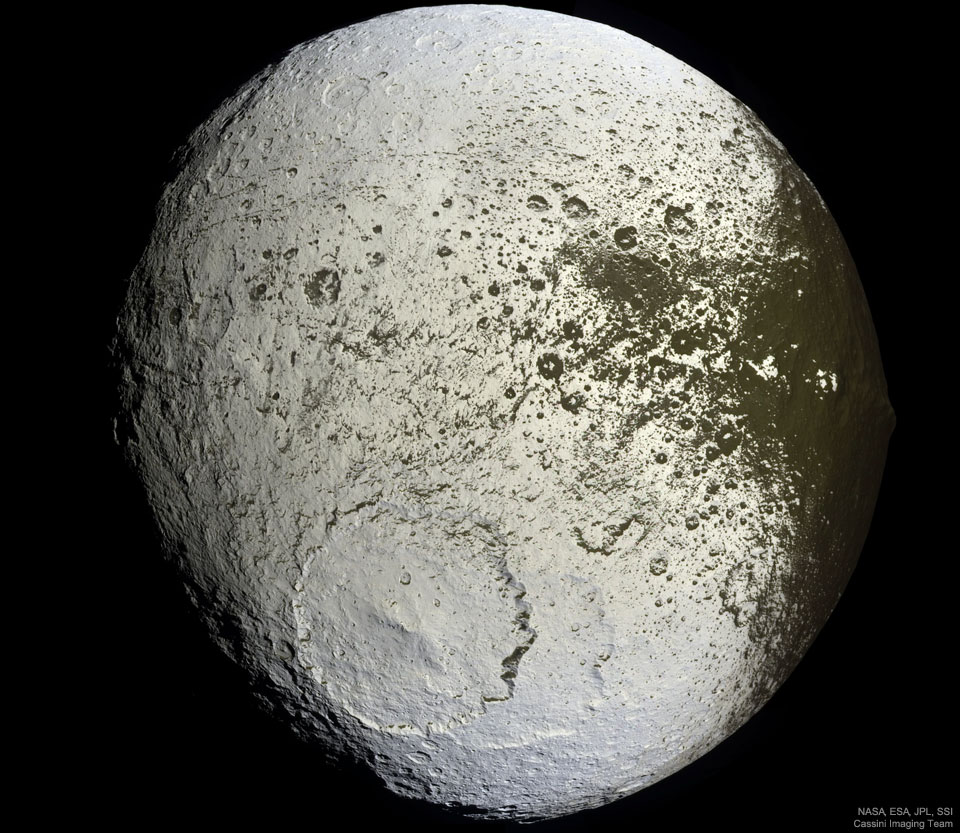
Saturn's Yin-Yang Moon: The Mystery of Iapetus's Two Tones

The Full Story

Among Saturn's many fascinating moons, Iapetus stands out as one of the most peculiar. It's nicknamed the "yin-yang moon" because one entire hemisphere is dramatically dark, almost like a piece of charcoal, while the other is brilliantly bright, reflecting sunlight like fresh snow. This striking contrast has puzzled astronomers for centuries, leading to wild theories and a quest to understand what could possibly create such a bizarre celestial object. The opportunity to unravel this mystery came in 2007 when NASA's robotic Cassini spacecraft, which orbited Saturn for over a decade, performed a daring close flyby of Iapetus. Cassini swooped within a mere 2,000 kilometers (about 1,200 miles) of the moon's surface, capturing incredibly detailed images and collecting vital data. From a distance of about 75,000 kilometers, the spacecraft snapped the iconic picture showing Iapetus's 'trailing' hemisphere – the side always facing away from its direction of orbit – revealing craters and highlands coated in this mysterious dark material. So, what's the leading hypothesis behind this cosmic paint job? Scientists believe the dark material is primarily carbon-rich soil, a dusty residue left behind when relatively warm, but dirty, ice on the moon's surface "sublimates." Sublimation is a fancy word for ice turning directly into a gas without first melting into liquid water, similar to how dry ice behaves. As the ice on the warmer, leading side of Iapetus sublimates, it leaves behind any non-volatile, darker impurities, effectively concentrating them into a dark, insulating layer. But why did it start on one side and not the other? And how did it become so extreme? One intriguing idea suggests that the process might have been jumpstarted by tiny bits of debris – like cosmic dust and rocks – that were kicked off other moons by meteor impacts. This debris, accreting onto Iapetus, could have initially painted a small area with a dark coating. Once a patch of dark material forms, it absorbs more sunlight, heats up, and accelerates the sublimation of surrounding ice, leaving even more dark material behind in a runaway process. It's a self-reinforcing cycle, like a snowball rolling downhill and getting bigger and faster. This incredible discovery isn't just about one strange moon; it offers a unique window into the diverse geological processes at play in our solar system. Iapetus acts as a natural laboratory, showing us how thermal effects, material composition, and even interactions with other celestial bodies can dramatically alter the appearance and evolution of a world. It reminds us that even familiar parts of our cosmic neighborhood still hold astonishing secrets waiting to be unveiled.

Key Takeaways

  • 1 Iapetus, one of Saturn's moons, is famously split into dramatically dark and bright hemispheres.
  • 2 NASA's Cassini spacecraft performed a close flyby in 2007, capturing detailed images that helped scientists study this mysterious phenomenon.
  • 3 The leading theory suggests the dark material is carbon-rich residue left behind as dirty ice on the moon's warmer side sublimates (turns directly into gas).
  • 4 It's thought that an initial coating of dust from other moons might have jumpstarted this self-reinforcing 'painting' process.

💡 Think of it this way:

Imagine a giant snowball, but one side is permanently covered in soot or coffee grounds. Or, think of a dirty ice cube melting – the clean ice evaporates, leaving the dirt behind. That's a bit like what might be happening on Iapetus.

How We Know This

The discovery was primarily made using the NASA Cassini spacecraft, a sophisticated robotic explorer that orbited Saturn for over 13 years. Scientists carefully planned a close flyby of Iapetus, maneuvering Cassini to within a very short distance of the moon's surface. During this flyby, the spacecraft used its powerful cameras and other instruments to capture incredibly high-resolution images and gather data on the moon's surface composition and temperature. By analyzing these detailed observations, scientists were able to map the distribution of the light and dark materials and develop the leading hypotheses about their origin.

What This Means

Understanding the unique thermal runaway process on Iapetus helps scientists refine their models of how moons and planets evolve and interact within a solar system. It provides crucial insights into how surface materials, orbital dynamics, and heat can drastically transform a celestial body over time. This knowledge can be applied to studying other icy worlds throughout our solar system and beyond, helping us predict their behavior and potentially identify unique environments that could sustain different forms of matter or even life. Future missions might seek similar phenomena on distant exomoons, expanding our understanding of planetary diversity.

Why It Matters

Understanding Iapetus helps us piece together the complex history of our solar system and the incredible processes that shape moons and planets. It shows us that even familiar celestial bodies can hold profound, unsolved mysteries, offering insights into how different materials behave in the harsh environment of space.

Related Topics

#Saturn #Iapetus #Moons #Planetary Science #Cassini