Back to Articles Image Of The Day

Cosmic Twins: The Dramatic Tale of Two Supernova Explosions

📖 3 min read 📊 beginner 🏷️ NASA APOD

In Brief

Imagine two massive stars born together. When the first one exploded as a supernova, it literally kicked its companion across space. Tens of thousands of years later, the runaway star also met its fiery end, leaving behind a second, overlapping cosmic explosion remnant.
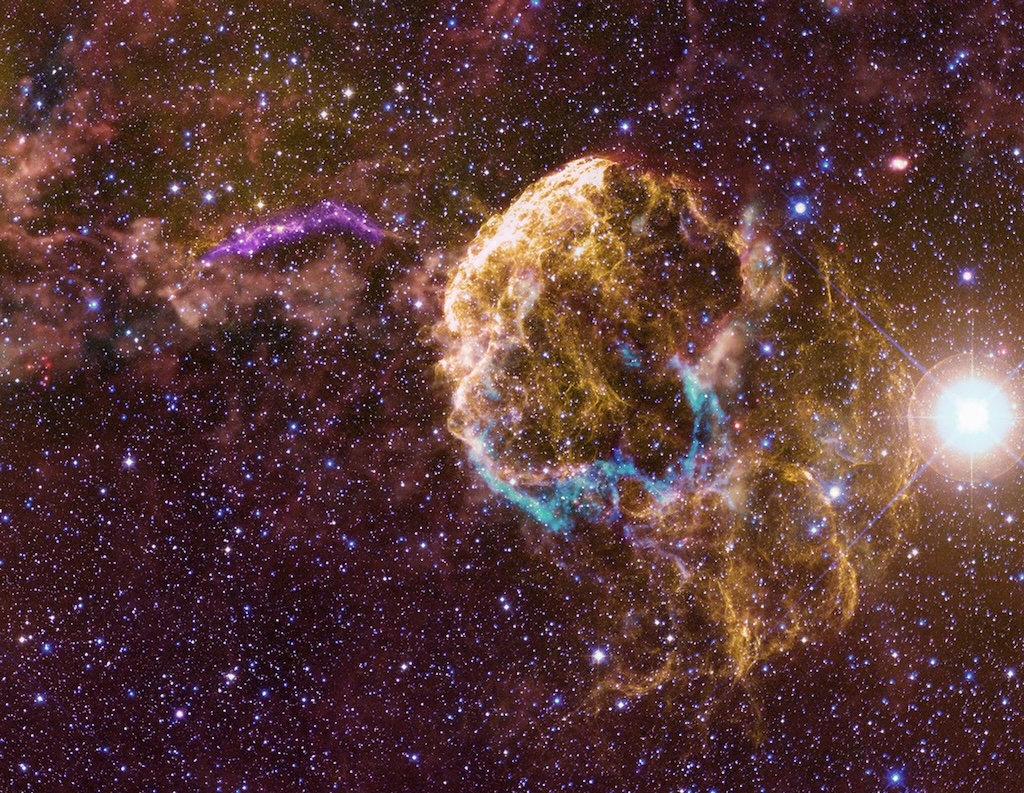
Cosmic Twins: The Dramatic Tale of Two Supernova Explosions

The Full Story

Gaze at this stunning celestial portrait, a cosmic canvas painted with light from different parts of the spectrum. In the center, glowing yellow, is the famous Jellyfish Nebula, a dazzling cloud left behind by a massive star's spectacular death. If it were visible to our naked eye, it would stretch larger than a full moon in our sky! But look closer, and you'll see ghostly purple filaments weaving through it. These are part of an *even older* explosion, an overlapping remnant known as G189.6+3.3. Why are these two cosmic explosions sharing the same space? That's where the real story begins. Astronomers now believe these two incredible remnants are like cosmic siblings, born from a dramatic sequence of events involving a pair of stars. Picture two colossal stars, bound together in a close gravitational dance – what scientists call a binary system. Massive stars don't just fade away; they end their lives in colossal explosions called supernovas, briefly outshining entire galaxies. But what happens when there are *two* of them? The journey began when the first star in the binary system reached the end of its life and detonated in a brilliant supernova. This explosion was so powerful that it didn't just obliterate the star; it gave its companion a tremendous "kick," sending it hurtling away through space at incredible speeds. For tens of thousands of years, this "runaway" star journeyed alone, until it too ran out of fuel. Finally, far from its original home but still in the same general cosmic neighborhood, it also exploded as a supernova, creating the second, younger Jellyfish Nebula we see today. It's a cosmic saga of separation and twin destruction. How did scientists unravel this incredible celestial drama? The vibrant visible (yellow), ultraviolet (purple), and infrared (cyan, red, orange) light captured in the image allowed them to map the remnants. But to piece together their intertwined past, they turned to NASA's Fermi Gamma-ray Space Telescope. Gamma-rays are the most energetic form of light, produced by extreme events like supernovas. By studying these high-energy signals from the remnants, astronomers could effectively trace the shockwaves and particle interactions, providing clues to their origins and the timeline of their dramatic explosions. The bright triple star system, Propus, visible on the right, is a fascinating neighbor, but not directly part of the siblings' story. Understanding these "sibling" supernovas isn't just about cosmic detective work; it's about understanding the very fabric of our universe. Supernovas are the universe's ultimate recycling plants, forging and scattering heavy elements – like the carbon in our bodies and the iron in our blood – across vast cosmic distances. This discovery sheds light on the complex evolution of massive binary stars, how they interact, and how their violent ends contribute to the grand cosmic cycle that eventually leads to the formation of new stars, planets, and potentially, life. It's a reminder that we are all, in a very real sense, made of stardust.

Key Takeaways

  • 1 Two overlapping supernova remnants, the Jellyfish Nebula and G189.6+3.3, are visible in a single region of space.
  • 2 These remnants originated from two stars in a binary system that exploded sequentially.
  • 3 The first supernova explosion 'kicked' its companion star away, which then exploded tens of thousands of years later, creating the second remnant.
  • 4 Astronomers used data from NASA's Fermi Gamma-ray Space Telescope, alongside visible, UV, and IR light, to uncover this dramatic cosmic story.
  • 5 This discovery helps us understand the evolution of massive binary stars and the crucial role of supernovas in enriching the universe with life-giving elements.

💡 Think of it this way:

It's like a cosmic game of billiards, where one star's explosion delivers a powerful 'break shot,' sending its partner flying across the table before *it* also spectacularly explodes.

How We Know This

Astronomers combined stunning images captured in visible, ultraviolet, and infrared light, which revealed the structure of the supernova remnants. Crucially, they analyzed high-energy gamma-ray data from NASA's Fermi Gamma-ray Space Telescope. Gamma-rays are like fingerprints of violent cosmic events, allowing scientists to study the extreme conditions within the remnants and piece together the timeline and sequence of the original stellar explosions.

What This Means

This research deepens our understanding of how massive stars evolve and die, especially when they are part of a binary system. It shows how powerful supernova explosions can dramatically influence their cosmic neighbors and propagate through space. Such events are vital for enriching the galaxy with heavy elements, which are the building blocks for future generations of stars, planets, and ultimately, life. Future studies might reveal more 'kicked-out' supernova pairs, further refining our models of stellar evolution and galactic chemical enrichment.

Why It Matters

This discovery helps us understand the violent life cycles of massive stars, how they interact in pairs, and how these powerful explosions create and distribute the elements essential for new stars, planets, and even life itself across the universe.

Related Topics

#supernova #binary stars #star evolution #nebulae #gamma-ray astronomy