Back to Articles Image Of The Day

Cosmic Cotton Candy: A Nearby Nursery Where Stars and Planets are Born

๐Ÿ“– 3 min read ๐Ÿ“Š beginner ๐Ÿท๏ธ NASA APOD

In Brief

This breathtaking image captures the Rho Ophiuchi complex, a vibrant cloud of gas and dust located relatively close to Earth. It's a bustling stellar nursery where hundreds of brand-new stars are actively forming, and we're even witnessing the very beginnings of planets taking shape.
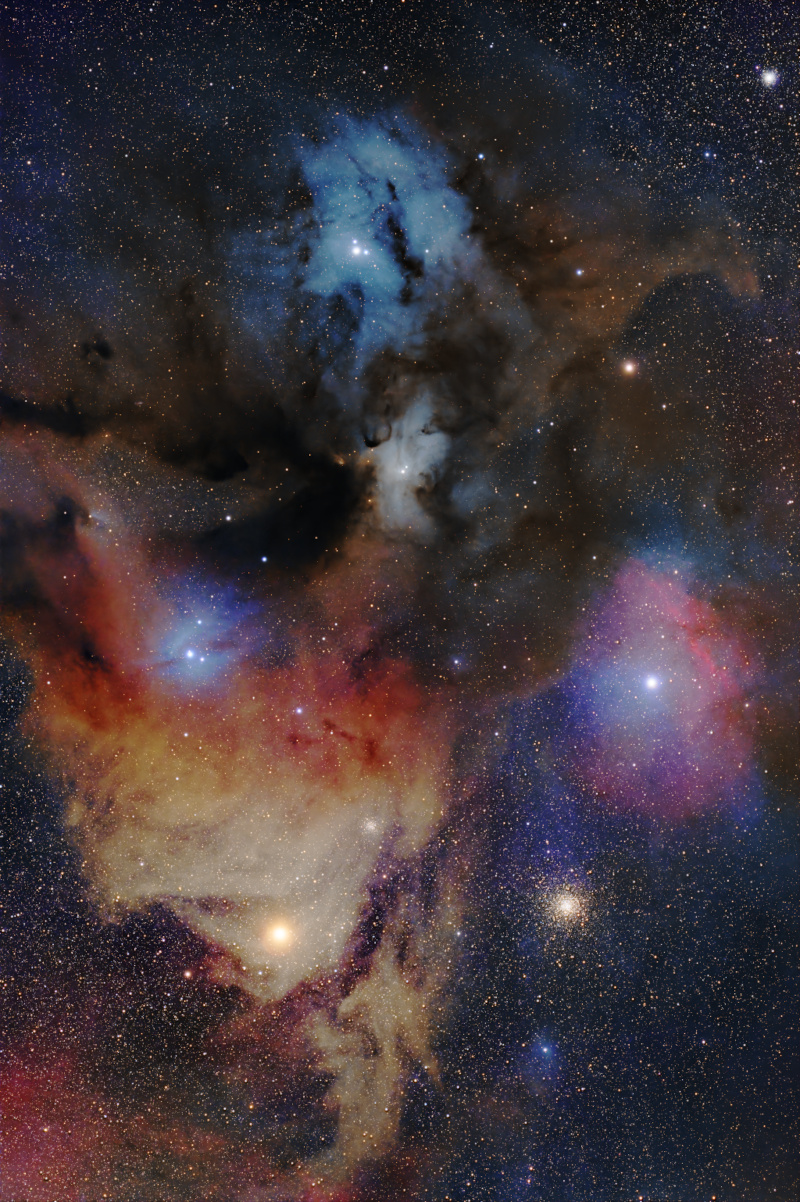
Cosmic Cotton Candy: A Nearby Nursery Where Stars and Planets are Born

The Full Story

Peering into the heart of our galaxy, we find the Rho Ophiuchi cloud complex, a truly spectacular sight often likened to cosmic cotton candy โ€“ though you definitely can't eat these swirling clouds! This vibrant region, captured in exquisite detail, is a nearby stellar nursery where the next generation of stars is bursting into existence. It's a rich tapestry, showcasing a dazzling array of cosmic phenomena, from the birth of stars to the very earliest stages of planet formation. The complexโ€™s kaleidoscope of colors tells a fascinating story. The brilliant blue hues you see are created by light from a central triple star system reflecting off tiny dust grains, much like how dust in our atmosphere scatters sunlight to make the sky blue. The fiery red glow comes from hydrogen gas that has been energized, or ionized, by intense ultraviolet light from hot, massive stars. Meanwhile, the striking yellow area is dramatically lit up by Antares, a monstrous red supergiant star so immense it could easily swallow our entire Solar System's asteroid belt. Amidst all this light, dark lanes of interstellar dust block some of the brilliance, adding depth and mystery to the cosmic canvas. Rho Ophiuchi is a hotbed of stellar youth. It's home to hundreds of young stellar objects, including protostars โ€“ stars that are still in their very early stages of formation, gathering material from their surroundings. We also see T Tauri stars, which are slightly older but still very young, known for their powerful stellar winds and dramatic flares. Observing these infant stars gives astronomers invaluable clues about how our own Sun came to be, roughly 4.6 billion years ago. Perhaps most exciting are the recent groundbreaking observations made by the James Webb Space Telescope (JWST). JWST's incredible infrared vision allowed it to peer through the obscuring dust and uncover hidden 'shadows' cast by what astronomers call circumstellar disks. These are flattened disks of gas and dust spinning around baby stars, and they are the cosmic construction sites where planets are born. Detecting these shadows is like finding the blueprints for new worlds, confirming that planet formation is actively underway in this dynamic region. Adding to the scene's complexity is Messier 4, an ancient globular cluster that appears in the bottom right of the image. This cluster of hundreds of thousands of stars is almost as old as the universe itself, serving as a silent, wise observer to the chaotic and energetic burst of youth happening in Rho Ophiuchi. It's a stark reminder of the vast timescales and diverse ages of objects coexisting within our Milky Way galaxy.

Key Takeaways

  • 1 Rho Ophiuchi is a nearby, active stellar nursery where hundreds of young stars are forming.
  • 2 The complex's vibrant colors (blue, red, yellow) are caused by different interactions of starlight, gas, and dust.
  • 3 The James Webb Space Telescope (JWST) revealed hidden disks of gas and dust around young stars, indicating early planet formation.
  • 4 The region showcases both incredibly young stars and an ancient globular cluster, illustrating the Milky Way's diverse stellar population.

๐Ÿ’ก Think of it this way:

Imagine a giant, colorful cosmic kindergarten. You've got little babies (protostars), energetic toddlers (young T Tauri stars), and even tiny clay pots where new 'play-doh' worlds (planets) are being sculpted, all while an ancient elder (a globular cluster) watches over the lively scene.

How We Know This

This stunning image was likely captured using powerful ground-based telescopes (potentially from Cรกdiz, Spain, as noted in the original summary) capable of gathering light across various wavelengths. The recent breakthrough observations regarding planet formation were made possible by the James Webb Space Telescope (JWST). JWST's unique ability to see in infrared light allows it to penetrate thick clouds of dust that obscure visible light, revealing previously hidden details like the shadows of planet-forming disks around young stars.

What This Means

Understanding Rho Ophiuchi helps us unlock the universal blueprint for how stars and planets, including our own, come into existence. The detection of these planet-forming disks by JWST offers unprecedented insights into the earliest moments of planetary system formation, which can help us determine how common Earth-like planets might be throughout the cosmos. Future observations will continue to monitor these young systems, potentially witnessing the growth and evolution of new worlds in nearly real-time, deepening our understanding of planetary habitability.

Why It Matters

This stunning cosmic snapshot gives us a front-row seat to the fundamental processes that built our own Sun and Solar System. By studying Rho Ophiuchi, we gain crucial insights into our cosmic origins and how common planet formation might be across the universe.

Related Topics

#Star Formation #Planet Formation #Nebulae #James Webb Space Telescope #Astronomy