Cigar Galaxy's Giant Cosmic Plume: Stellar Winds Unveiled
In Brief
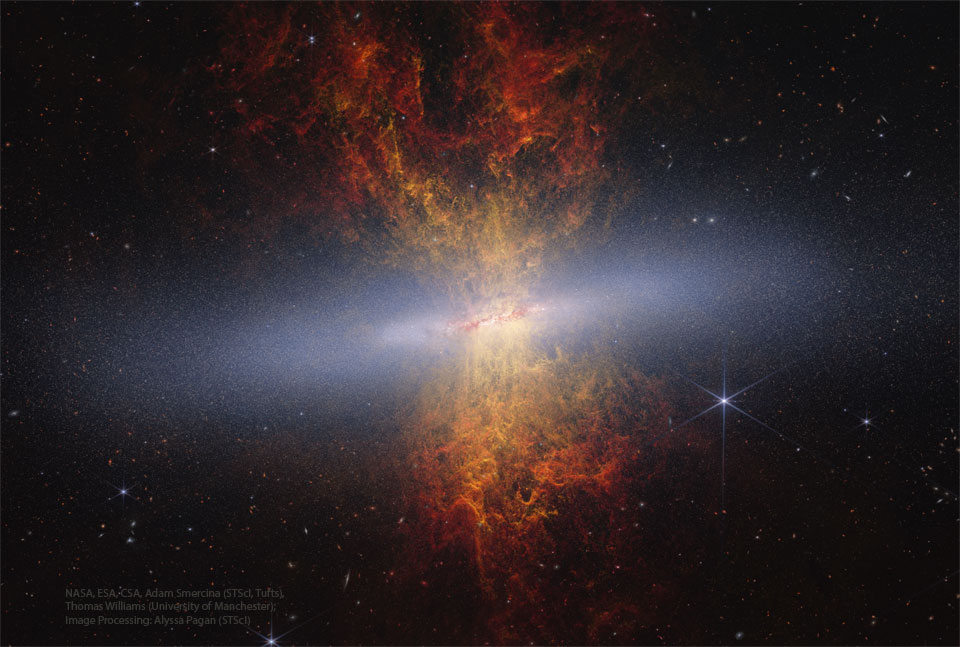
The famous Cigar Galaxy (M82) is observed billowing immense clouds of red, glowing gas and dust, resembling smoke. Scientists have uncovered that this spectacular outflow, stretching over 10,000 light-years, is largely powered by the collective "winds" of countless young, active stars. This cosmic expulsion helps explain how galaxies recycle their material and evolve.
The Full Story
Key Takeaways
- 1 The Cigar Galaxy (M82) is expelling a massive plume of glowing gas and dust.
- 2 This "galactic superwind" is primarily driven by the collective energy of countless young, active stars.
- 3 The expelled material, resembling cigar smoke particles, stretches for over 10,000 light-years.
- 4 These superwinds are crucial for understanding how galaxies evolve, regulate star formation, and recycle cosmic material.
💡 Think of it this way:
Imagine a bustling cosmic city where millions of active 'star-factories' are collectively pushing out a giant plume of 'smoke,' helping to shape the galaxy's future.
How We Know This
To capture this breathtaking view, astronomers combined the sharp vision of two of humanity's most powerful space telescopes. The iconic Hubble Space Telescope provided images in visible light, showcasing the galaxy's structure and bright star-forming regions. Meanwhile, the James Webb Space Telescope contributed infrared light observations, which are crucial for peering through the dust and revealing the hidden structures and the heat from the expelled gas and dust. Combining these perspectives created a comprehensive mosaic, allowing scientists to see both the familiar and the previously unseen aspects of M82's dramatic outflow.
What This Means
Further study of M82's superwind will help scientists refine models of galaxy evolution, particularly for starburst galaxies and those undergoing intense interactions. By tracking the expelled material, researchers can better understand how heavy elements, forged inside stars, are distributed throughout the universe and how these outflows impact the intergalactic medium. This research will also inform our understanding of how galaxies can self-regulate their star formation, preventing them from 'burning out' too quickly or growing uncontrollably, ultimately shaping their long-term destiny.
Why It Matters
Understanding how galaxies expel gas and dust helps us grasp how they regulate their star formation, grow, and interact with their surroundings. This process is crucial for the cosmic cycle, influencing the birth of new stars and planets across the universe, including our own Milky Way.