Back to Articles Image Of The Day

Daylight Hide-and-Seek: Moon Briefly Hides Brilliant Venus!

📖 3 min read 📊 beginner 🏷️ NASA APOD

In Brief

Imagine the Moon playing a cosmic game of hide-and-seek, not just at night, but in the middle of the day! Recently, our brilliant 'Evening Star' Venus briefly vanished behind the slender crescent Moon, a rare event caught by keen skywatchers. This stunning daylight occultation reminds us of the dynamic celestial ballet constantly unfolding above.
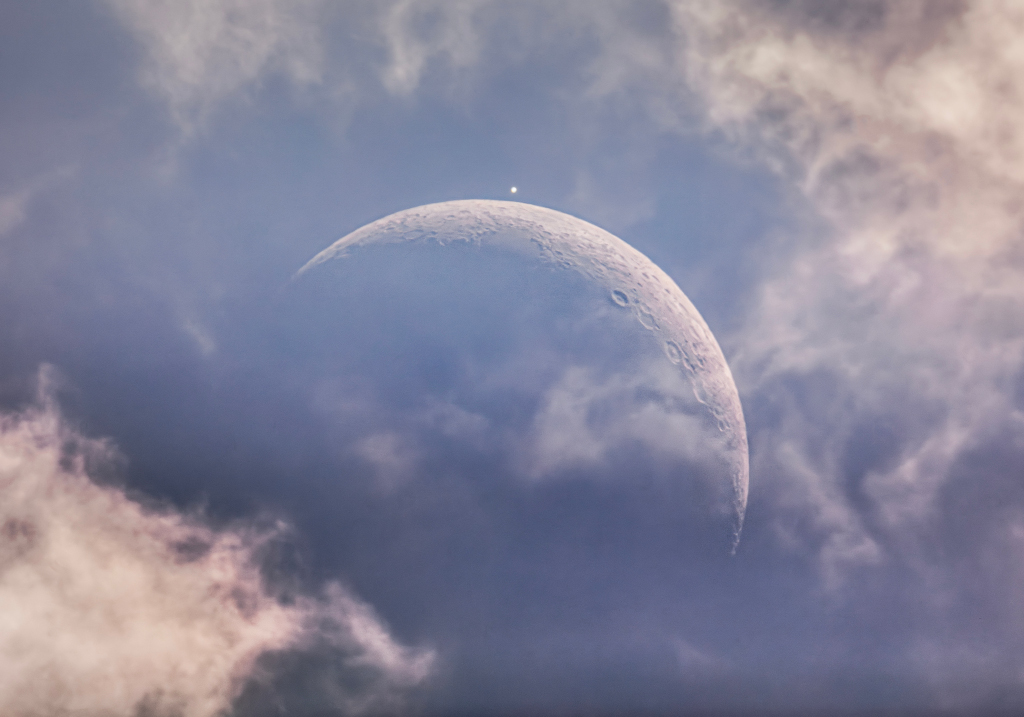
Daylight Hide-and-Seek: Moon Briefly Hides Brilliant Venus!

The Full Story

On June 17th, skygazers across parts of Earth were treated to a special celestial alignment involving our nearest cosmic neighbors: the Moon and Venus. Venus, often dubbed the 'Evening Star' (or 'Morning Star' depending on its position), is the second planet from the Sun and the brightest object in our sky after the Sun and Moon. Its dazzling brilliance makes it a favorite target for observers, easily spotted even without a telescope. What made this particular evening so special was the rare phenomenon known as an 'occultation.' In astronomy, an occultation happens when one celestial body passes in front of another, temporarily blocking its view from Earth. While lunar occultations of planets aren't exceedingly rare, catching one in broad daylight is much less common and far more challenging. The bright daytime sky usually washes out fainter objects, but Venus's incredible luminosity allows it to punch through the sunlight. From certain locations, particularly in southern British Columbia, Canada, observers with the right equipment had a front-row seat to this cosmic spectacle. Despite dramatically cloudy skies, a dedicated backyard observatory managed to capture the event. The image shows the dramatic moment after Venus had already spent an hour hidden behind the Moon's limb – its curved edge – as it re-emerged into view, looking like a tiny, brilliant diamond peeking out from behind a colossal grey pearl. This event is a beautiful testament to the precision of celestial mechanics. The Moon and planets are constantly in motion, following predictable paths around the Sun and Earth. These occasional alignments, like the Moon passing directly in front of Venus, are a direct visual confirmation of their orbital dance. It's a reminder that even without advanced scientific instruments, we can observe and appreciate the intricate workings of our solar system directly from our own planet. Such events also highlight the accessibility of astronomy. While professional observatories use cutting-edge technology, this capture from a 'backyard observatory' demonstrates that amateur astronomers, armed with a telescope and a keen eye, can contribute to and enjoy significant celestial observations. It's a hobby that bridges science and wonder, allowing anyone to be a part of the grand cosmic theater.

Key Takeaways

  • 1 The Moon briefly passed in front of Venus, an event called an occultation.
  • 2 This rare occultation was visible and captured in broad daylight, thanks to Venus's extreme brightness.
  • 3 A backyard observatory in British Columbia successfully photographed Venus re-emerging from behind the Moon.
  • 4 It's a beautiful example of predictable celestial mechanics visible from Earth.

💡 Think of it this way:

Think of it like watching a very bright light bulb briefly disappear behind a passing car in broad daylight. You wouldn't normally see the car's outline against the bright sky, but the light bulb is so brilliant that its disappearance is still noticeable, even when the car is just a silhouette.

How We Know This

This stunning observation was made using a telescope from a 'backyard observatory' – a setup often used by amateur astronomers. Telescopes gather much more light than the human eye, making it possible to spot bright objects like Venus even against a daylight sky. A 'telescopic snapshot' indicates a photograph taken through the telescope, capturing the fleeting moment of Venus re-emerging from behind the Moon.

What This Means

Witnessing events like the daytime occultation of Venus encourages more people to look up and engage with astronomy. It serves as a powerful visual aid for understanding orbital mechanics and the dynamic nature of our solar system. For aspiring astronomers, it demonstrates that significant and beautiful observations can be made from accessible setups, fostering curiosity and participation in the scientific community, even from one's own backyard.

Why It Matters

This captivating event offers a fantastic, accessible way for anyone to connect with the cosmos. It highlights the predictable yet stunning movements of objects in our solar system, proving that incredible astronomical shows aren't always reserved for powerful observatories or nighttime viewing.

Related Topics

#Venus #Moon #Occultation #Astronomy #Skywatching #Solar System