Back to Articles Image Of The Day

Cosmic Neighbors: A Spiral Galaxy, a Supernova, and a Double Ring Mystery

📖 3 min read 📊 beginner 🏷️ NASA APOD

In Brief

Astronomers have captured a breathtaking image featuring two distant galaxies and a surprise supernova. While one galaxy, NGC 3660, is a familiar spiral like our Milky Way, the other, known as Burçin's galaxy, puzzles scientists with its unusual double ring of stars. This cosmic snapshot offers valuable clues into the universe's grand evolution.
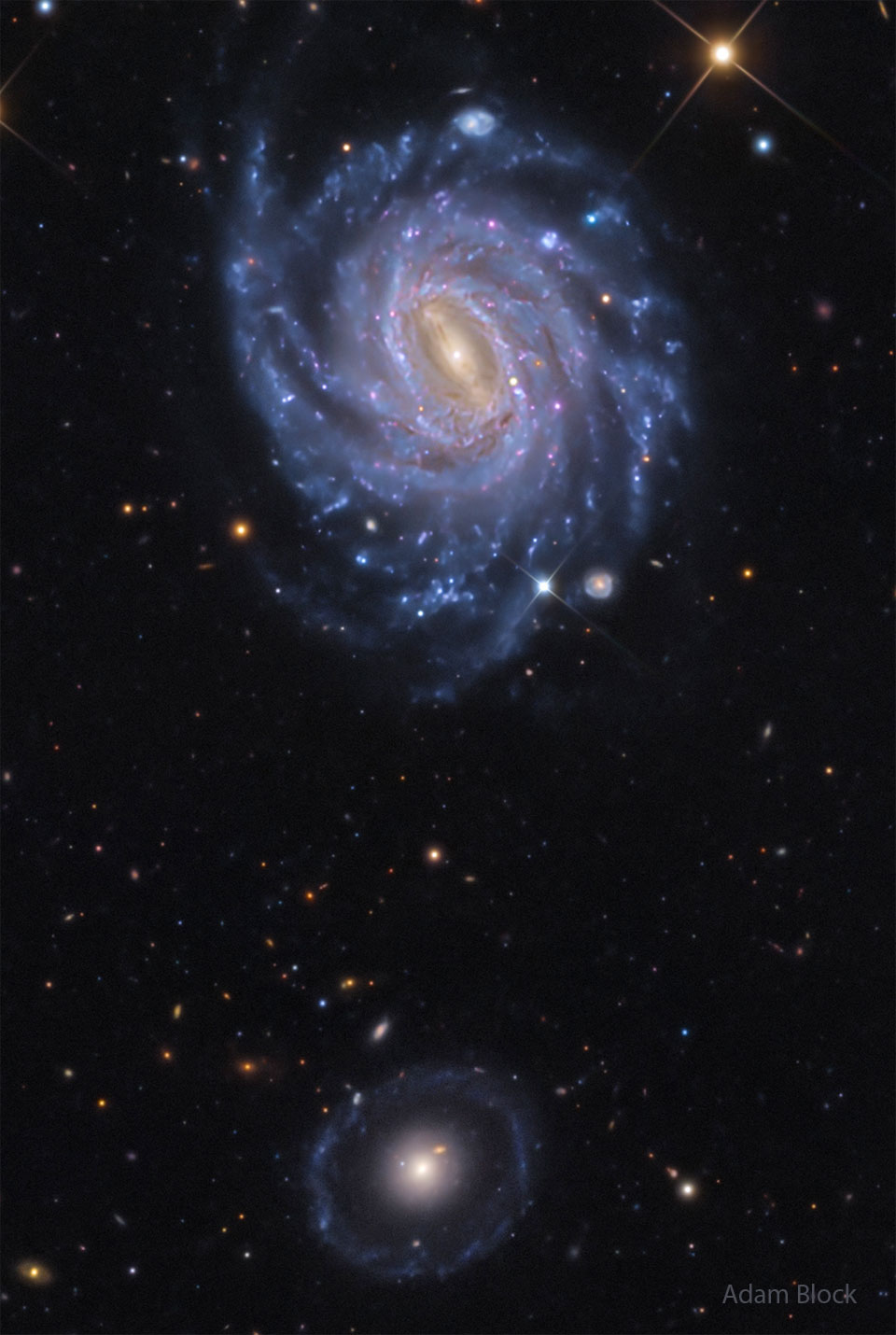
Cosmic Neighbors: A Spiral Galaxy, a Supernova, and a Double Ring Mystery

Disclosure: This post contains affiliate links. As an Amazon Associate, I earn from qualifying purchases.

The Full Story

Gazing into the depths of space, astronomers recently captured a spectacular view that showcases two fascinating galaxies and a stellar surprise. The galaxy taking center stage in the upper part of the image is NGC 3660, a beautiful spiral galaxy that bears a striking resemblance to our very own Milky Way. Much like our galactic home, NGC 3660 boasts several bright, blue spiral arms — regions where new stars are actively being born — and a prominent central bar, a dense collection of stars, gas, and dust. Adding an unexpected twist to this cosmic portrait is the discovery of SN 2026cff, a supernova. A supernova is the incredibly powerful explosion of a star at the end of its life, briefly outshining an entire galaxy. This particular supernova was found by chance, shining brightly just to the right of NGC 3660's central bar. Catching such a fleeting, spectacular event in a single deep-space image is a stroke of luck, providing astronomers with a direct look at the dramatic lifecycle of stars in distant galaxies. Further in the background, making its appearance at the bottom of the image, lies the truly enigmatic 'Burçin's galaxy,' formally cataloged as LEDA 1000714. This galaxy immediately stands out because its structure is unlike anything we commonly see. At its heart appears to be an old, football-shaped elliptical galaxy – a type of galaxy typically devoid of the active star formation seen in spirals. However, what makes Burçin's galaxy so extraordinary is that this ancient core is surrounded by not one, but two distinct, concentric rings of stars. The formation of these double rings around an elliptical core is a profound mystery and an active area of research. Such structures are incredibly rare, challenging our current understanding of how galaxies evolve. Scientists hypothesize that Burçin's galaxy likely acquired these rings by gravitationally pulling in and 'swallowing' one or more smaller galaxies over cosmic timescales. These smaller galaxies, torn apart by the larger galaxy's gravity, would have had their stars and gas settle into these peculiar ring formations. Continuing to study these cosmic interactions helps us understand the violent and beautiful processes that sculpt the universe we see today. Images like this, captured by powerful telescopes gathering light from billions of years ago, are more than just pretty pictures; they are vital pieces of a cosmic puzzle. They offer astronomers unique 'snapshots' of galactic evolution in progress, helping them refine theories about galaxy formation, mergers, and the grand cosmic dance that shapes the universe. Unraveling the secrets of galaxies like Burçin's can shed light on the diverse and often unexpected pathways galaxies take as they mature and interact across the vastness of space.

Key Takeaways

  • 1 A stunning image captured two distinct galaxies: a familiar spiral (NGC 3660) and a mysterious, rare double-ringed galaxy (Burçin's galaxy).
  • 2 A supernova (SN 2026cff), the dramatic explosion of a star, was serendipitously caught in the spiral galaxy.
  • 3 Burçin's galaxy has an ancient elliptical core surrounded by two concentric rings of stars, a formation that puzzles scientists.
  • 4 The unusual structure of Burçin's galaxy likely formed from the 'accretion' or absorption of smaller galaxies.
  • 5 Observations like these provide crucial insights into galaxy evolution, stellar lifecycles, and the dynamic nature of the universe.
Hubble Space Telescope Deep Field Poster

Hubble Space Telescope Deep Field Poster

Stunning poster featuring iconic Hubble Space Telescope imagery. Perfect for space enthusiasts.

Check Price on Amazon
*As an Amazon Associate, we earn from qualifying purchases.

đź’ˇ Think of it this way:

Imagine discovering a bustling, familiar city (NGC 3660) in deep space, and suddenly a massive fireworks display (the supernova) erupts within it. Next to it, you find an ancient, mysterious fortress (Burçin's galaxy) with not one, but two concentric walls, whose builders and purpose are still a complete enigma. This cosmic scene is like stumbling upon a hidden chapter in the universe's history book!

How We Know This

This captivating image was captured using a powerful telescope during a 'deep exposure,' meaning the telescope collected light for an extended period. This method allows it to gather faint light from extremely distant objects, revealing incredible detail and color that would be invisible to the naked eye. The image essentially acts as a cosmic time machine, bringing light from billions of years ago to our instruments.

What This Means

The ongoing study of Burçin's galaxy is crucial for understanding the rarer and more complex paths of galaxy evolution. Future research will likely involve advanced computer simulations to model how such double-ringed structures could form through galactic mergers or accretion events. Discoveries like this help scientists refine our overall models of how galaxies grow, interact, and change over cosmic history, giving us a more complete picture of the universe's past, present, and future.

Why It Matters

Understanding these rare galactic structures and explosive star deaths helps us piece together the universe's incredible story. It provides insights into how galaxies, including our own Milky Way, form and change over billions of years, and reminds us of the dynamic, ever-changing nature of the cosmos far beyond our home.

Related Topics

#Galaxies #Supernova #Cosmic Mysteries #Galaxy Evolution #Astronomy