Giant Space Blobs That Could Form Stars Are Melting Away
In Brief
Astronomers are studying strange, dark clouds of gas and dust called Thackeray's Globules, nestled within a vibrant stellar nursery. These massive cosmic blobs, capable of forming new stars, are slowly being eroded by the intense radiation from surrounding young, hot stars.
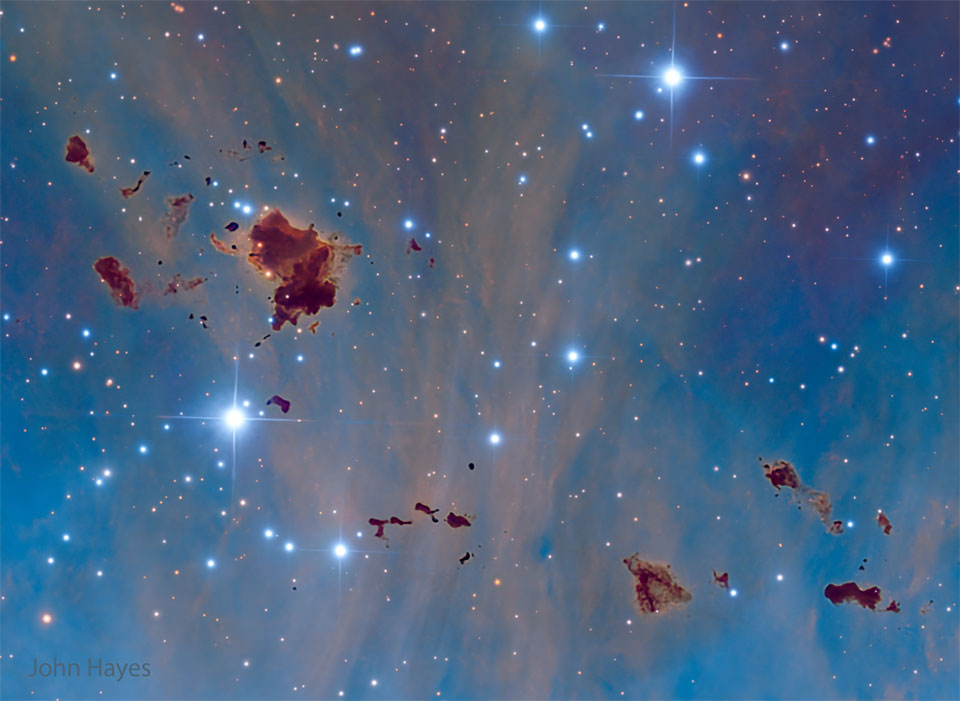
The Full Story
Key Takeaways
- 1 Thackeray's Globules are dark, dense clouds of gas and dust that could potentially form new stars.
- 2 They are located in IC 2944, a bright and active 'stellar nursery' where many young stars are being born.
- 3 Intense ultraviolet radiation from these young, hot stars is causing the globules to slowly erode and dissipate.
💡 Think of it this way:
Imagine a lump of butter melting and breaking apart in a sizzling hot frying pan; that's what's happening to these cosmic blobs.
How We Know This
Astronomers first spotted these mysterious dark blobs over 70 years ago using a telescope in South Africa. More recently, powerful instruments like the Hubble Space Telescope, with additional data from observatories like El Sauce in Chile, have provided incredibly detailed images. These images, often combining different colors of light (known as a 'Hubble palette' image), help scientists see through the cosmic dust and gas, revealing the globules' intricate structure and how they're interacting with their energetic environment.
What This Means
Studying Thackeray's Globules helps us build a clearer picture of the harsh and dynamic environments where new stars are born. It shows us that star formation isn't always a peaceful process, but a constant battle between creation and destruction. Future observations will continue to monitor these fascinating objects, providing clues about the ultimate fate of gas and dust in active stellar nurseries and how that impacts the types of stars and planetary systems that can form.
Why It Matters
Understanding these 'melting' space clouds helps us unravel the mysteries of how stars, planets, and even our own solar system came to be. It's a peek into the dramatic cosmic forces that shape galaxies and the building blocks of the universe.