Back to Articles Image Of The Day

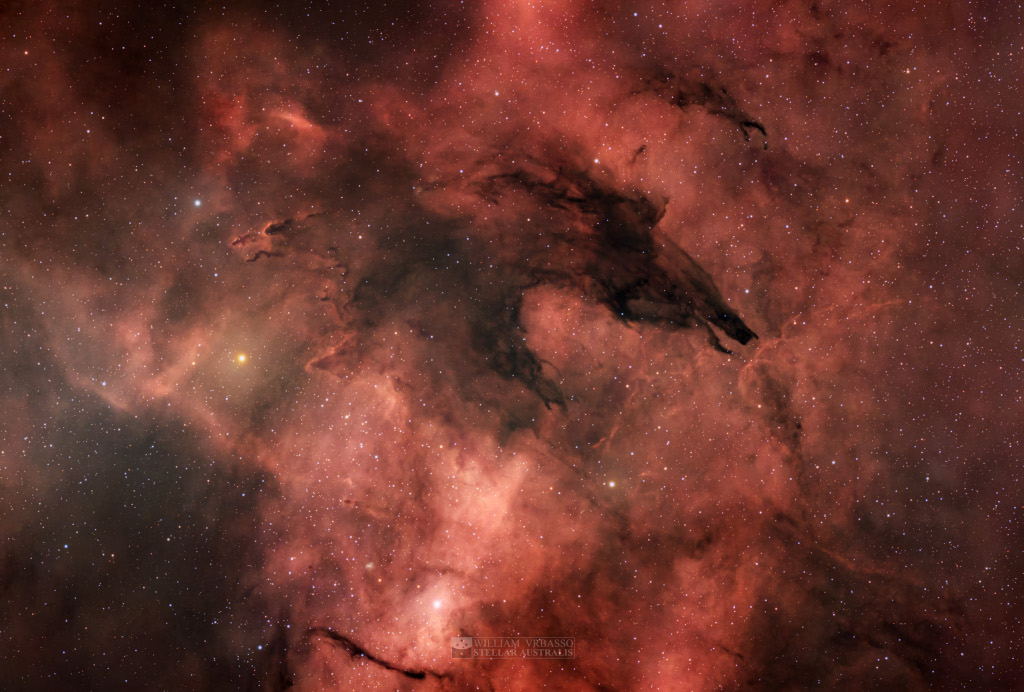
The Dark Wolf Nebula: A Cosmic Nursery's Secret Ingredient

📖 4 min read 📊 beginner 🏷️ NASA APOD

In Brief

Behold the 'Dark Wolf Nebula,' a mysterious cloud of cosmic dust within the Scorpius constellation. Far from being empty space, this dark region plays a crucial role in creating new stars by cooling gas and helping hydrogen atoms find each other. What looks like a void is actually a bustling stellar factory!
The Dark Wolf Nebula: A Cosmic Nursery's Secret Ingredient

Disclosure: This post contains affiliate links. As an Amazon Associate, I earn from qualifying purchases.

The Full Story

Peering into the vast expanse of the Scorpius constellation, astronomers have captured an image of a fascinating region known as the Dark Wolf Nebula, officially designated Sandqvist–Lindroos 17. This isn't a mythical creature, but a dense, dark cloud of cosmic dust nestled within the larger Gum 55 Nebula (also known as RCW 113). While these dark patches might appear empty or ominous in visible light, they are, in fact, incredibly dynamic and vital components of our galaxy's ecosystem. At first glance, dust in space might seem like a nuisance, obscuring our view of distant objects. However, the Dark Wolf Nebula showcases just how critical this 'cosmic grit' is for the birth of stars. This nebula acts like a giant interstellar thermostat. It absorbs the intense ultraviolet and visible light radiating from hot, young stars nearby in Gum 55. Instead of letting this high-energy light heat up the surrounding gas, the dust re-emits the energy at much longer, mainly infrared, wavelengths. This process effectively cools the entire region down. Why is cooling so important? Imagine trying to build a stable tower with bouncy balls compared to solid bricks. Star formation works similarly. For gas to collapse under its own gravity and form a new star, it needs to be incredibly cold and dense. The cooling action of the dust prevents the gas from becoming too energetic and scattered, allowing gravity to slowly but surely pull the gas molecules closer together until they form a stellar embryo. Without this cooling, the process of star birth would be far less efficient, or perhaps even impossible, in many regions of space. But the dust's role doesn't stop there. It also serves as a cosmic 'meet-cute' location for single hydrogen atoms. In the cold, dark environment of the dust cloud, individual hydrogen atoms can stick to the surface of dust grains. This allows them to encounter other hydrogen atoms and bond, forming molecular hydrogen (H2). Molecular hydrogen is the primary raw material—the fundamental building block—for new stars. Without these dust grains facilitating their union, the formation of enough molecular hydrogen for star birth would be significantly hindered. So, despite its seemingly sinister name and appearance, the Dark Wolf Nebula is far from an empty, foreboding void. Instead, it is a bustling cosmic nursery, actively involved in the creation of new stars. It reminds us that even the darkest corners of space can harbor the most fundamental processes of life, acting as a crucial harbinger of cosmic creativity and stellar evolution.

Key Takeaways

  • 1 The Dark Wolf Nebula is a dark dust cloud vital for creating new stars.
  • 2 Cosmic dust acts as an 'interstellar thermostat,' cooling gas by absorbing high-energy light and re-emitting infrared.
  • 3 Dust also helps individual hydrogen atoms combine to form molecular hydrogen, the primary fuel for stars.
Hubble Space Telescope Deep Field Poster

Hubble Space Telescope Deep Field Poster

Stunning poster featuring iconic Hubble Space Telescope imagery. Perfect for space enthusiasts.

Check Price on Amazon
*As an Amazon Associate, we earn from qualifying purchases.

💡 Think of it this way:

Think of the Dark Wolf Nebula as an interstellar air conditioner and matchmaker, setting the perfect cool conditions and bringing together the right ingredients for new stars to emerge.

How We Know This

Astronomers use powerful telescopes, often combining observations from both visible light and infrared wavelengths, to study nebulae like the Dark Wolf. While visible light reveals its dark, obscuring nature, infrared cameras can pierce through the dust. By analyzing the light emitted and absorbed, scientists can map the dust and gas, determine their temperatures, and understand the intricate physical processes at play within these star-forming regions.

What This Means

Studying regions like the Dark Wolf Nebula provides invaluable insights into the universal process of star formation, a cornerstone of astrophysics. This knowledge helps us understand how our own Sun and solar system came to be, how galaxies evolve over billions of years, and where the building blocks of planets and life originate. By decoding these cosmic nurseries, we gain a deeper appreciation for the complex interplay of forces that shape the universe around us, and our place within it.

Why It Matters

Understanding nebulae like the Dark Wolf helps us unlock the fundamental secrets of how stars, including our own Sun, are born across the universe. It sheds light on the cosmic origins of all matter and life.

Related Topics

#Nebula #Star Formation #Cosmic Dust #Astronomy #Scorpius