Back to Articles Image Of The Day

Dancing Lights: Earth's Aurora From Space

📖 3 min read 📊 beginner 🏷️ NASA APOD

In Brief

The International Space Station captured a breathtaking view of Earth's aurora, glowing vibrant green and rare red, from its unique vantage point above our planet. Orbiting right inside this natural light show, astronauts witnessed our atmosphere come alive with electrifying colors caused by energized particles.
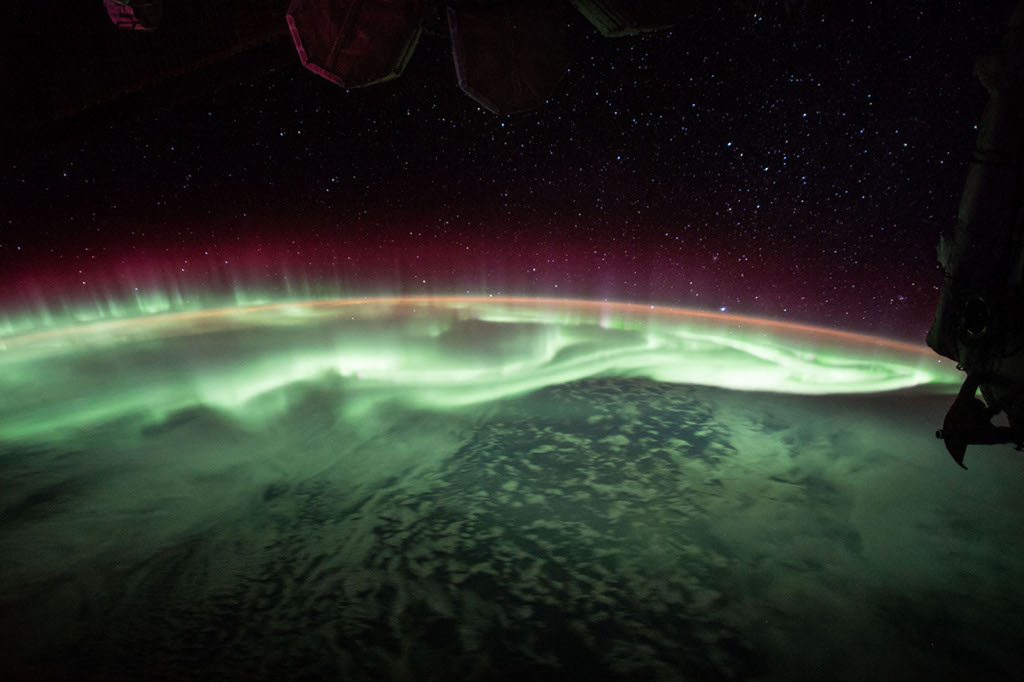
Dancing Lights: Earth's Aurora From Space

Disclosure: This post contains affiliate links. As an Amazon Associate, I earn from qualifying purchases.

The Full Story

From its perch about 400 kilometers (250 miles) above Earth, the International Space Station (ISS) offers a front-row seat to some of our planet's most spectacular natural phenomena. One stunning example is this snapshot from June 25, 2017, where the ISS was bathed in the ethereal glow of a powerful aurora. Unlike ground observers who look up at the aurora, the station was actually flying *within* the upper reaches of this magnificent light show, offering an unparalleled perspective of the green and rare reddish bands painting the sky.So, what creates these mesmerizing colors? It all starts with the Sun. Our star constantly emits a stream of charged particles, often called the solar wind. When these particles reach Earth, they're mostly deflected by our planet's magnetic field. However, near the magnetic poles, some particles sneak through and collide with atoms and molecules in Earth's upper atmosphere. These collisions energize the atmospheric gases, causing them to emit light – much like a neon sign glows when electricity passes through it.The specific colors we see depend on the type of gas and the altitude where the collisions occur. In this stunning view, the dominant green glow comes from atomic oxygen, energized at lower altitudes within the aurora. Higher up, where the air is even thinner and conditions are slightly different, rare reddish bands of light can be seen, also produced by atomic oxygen, but under different energy states. These crimson streaks extend tantalizingly above the space station's horizon, highlighting the layered nature of this atmospheric spectacle.This particular display was captured as the ISS orbited over a point south and east of Australia. Looking up from this unique vantage point, astronauts could also admire the cosmos. Stars from the constellation Canis Major, famously known as Orion's big dog, sparkled above the horizon on the right. Among them, Sirius, the brightest star in Canis Major and indeed the brightest star in our night sky, shone brilliantly near Earth's curved limb, adding a celestial backdrop to our planet's own dazzling light show.Such observations from the ISS are more than just pretty pictures. They provide scientists with valuable data on how solar activity interacts with Earth's magnetosphere and atmosphere. By studying the aurora's intensity, color, and altitude, researchers can better understand space weather events, which have practical implications for protecting orbiting satellites, communication systems, and even power grids on Earth from solar disturbances.

Key Takeaways

  • 1 The International Space Station captured a unique 'inside' view of Earth's aurora.
  • 2 Auroras are caused by solar particles colliding with atmospheric gases, making them glow.
  • 3 Green colors are primarily from atomic oxygen at lower altitudes; rarer red bands are from oxygen at higher altitudes.
  • 4 Observations from space help scientists understand space weather and protect technology on Earth and in orbit.
National Geographic Planisphere Star Finder

National Geographic Planisphere Star Finder

Essential tool for identifying constellations and stars. Perfect for beginners learning the night sky.

Check Price on Amazon
*As an Amazon Associate, we earn from qualifying purchases.

💡 Think of it this way:

Imagine being an astronaut watching a colossal, silent fireworks display erupt all around you, but instead of chemicals, it's caused by the Sun's energy making our atmosphere glow.

How We Know This

This breathtaking image was captured by astronauts aboard the International Space Station (ISS). The ISS, a large spacecraft orbiting Earth, serves as a unique platform for observing our planet from above. Equipped with various cameras and scientific instruments, it allows humans to witness and document atmospheric phenomena like the aurora firsthand, providing a perspective impossible to achieve from the ground.

What This Means

Continued observation of auroras from space helps scientists refine models of Earth's magnetic field and its interaction with the Sun. This knowledge is crucial for predicting 'space weather' events, which can disrupt satellite communications, GPS signals, and even power grids. By understanding these phenomena better, we can develop strategies to protect our increasingly technology-dependent society and ensure the safety of future space missions.

Why It Matters

Understanding auroras isn't just about beautiful lights; it helps scientists study how Earth's protective magnetic field interacts with particles from the Sun. This 'space weather' can impact our satellites, power grids, and even future space missions, making these observations crucial for our technological future.

Related Topics

#Aurora #ISS #Space Weather #Earth Atmosphere #Astronomy