Back to Articles Image Of The Day

Your Cosmic Cheat Sheet: Exploring 110 Stellar Sights with the Messier Catalog

πŸ“– 3 min read πŸ“Š beginner 🏷️ NASA APOD

In Brief

An exciting new image compiles all 110 famous Messier objects, from glittering star clusters to colossal galaxies, displayed side-by-side at the same magnification. This unique visual guide offers a fresh perspective on these cosmic wonders, making it easier than ever to appreciate their diversity and beauty.
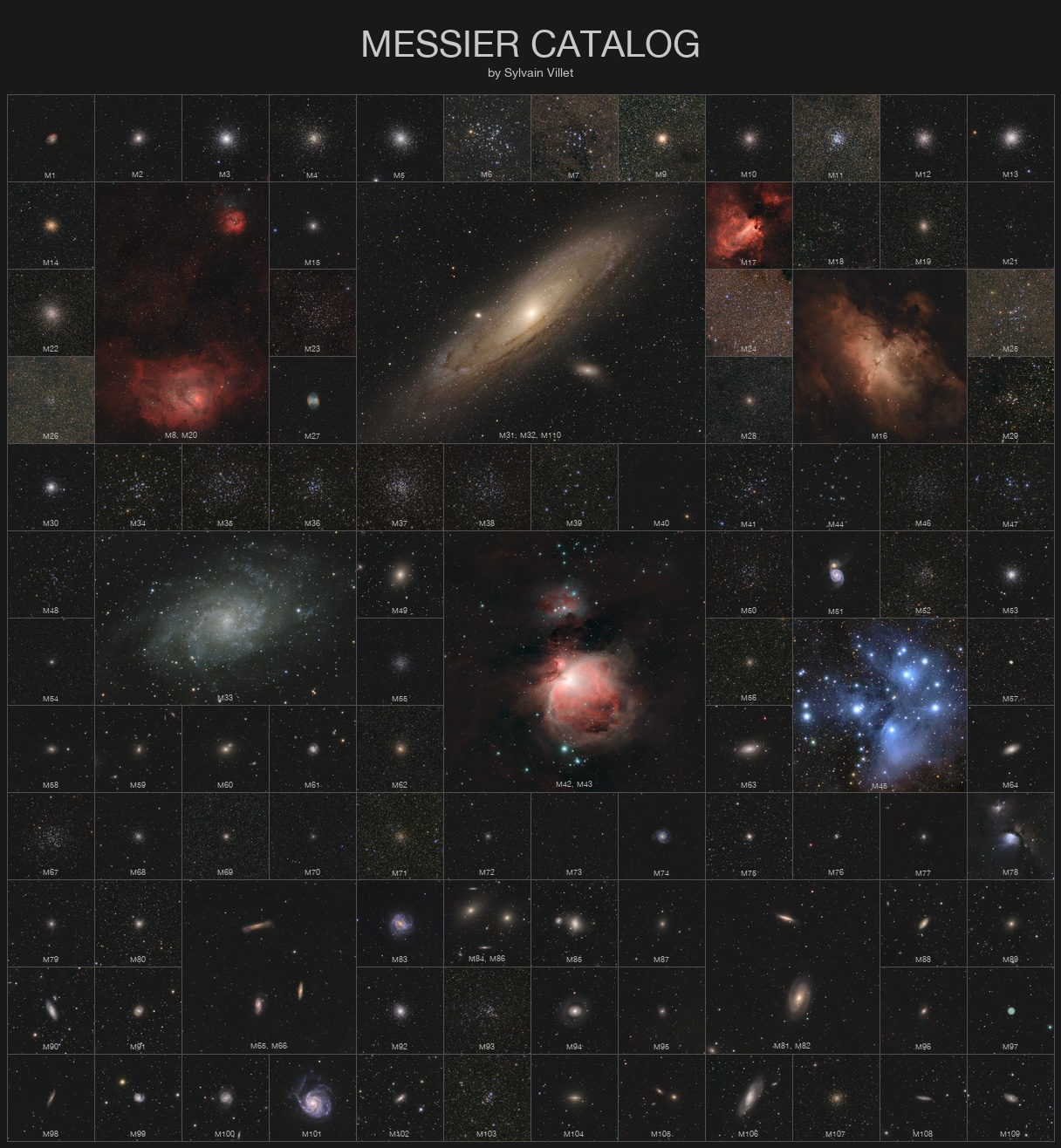
Your Cosmic Cheat Sheet: Exploring 110 Stellar Sights with the Messier Catalog

Disclosure: This post contains affiliate links. As an Amazon Associate, I earn from qualifying purchases.

The Full Story

Imagine having a detailed map to some of the most spectacular sights in the night sky, all conveniently listed and shown at the same 'zoom level.' That's exactly what a recent astronomical compilation offers: an incredible visual featuring all 110 objects from the famous Messier Catalog, presented at a uniform scale. This means whether you're looking at a sprawling galaxy or a compact star cluster, they appear at the same relative magnification, providing an unprecedented way to compare their true sizes and structures from our perspective on Earth. This collection is a treasure trove for anyone eager to explore the cosmos. The Messier Catalog itself has a fascinating origin story. It was created in the 18th century by French astronomer Charles Messier, who wasn't actually trying to discover new wonders. Instead, he was a dedicated comet hunter, and these fuzzy, comet-like objects were simply nuisances! He compiled his list as a catalog of 'objects to avoid' – known celestial bodies that could be mistaken for new comets. Irony of ironies, his 'avoid list' became one of the most celebrated and useful guides for amateur astronomers today, helping millions locate some of the universe's most iconic features. So, what kinds of celestial marvels made it onto Messier’s 'avoid list'? The catalog is incredibly diverse. It includes stunning star-forming nurseries like the Orion Nebula (M42), where new stars are being born; breathtaking galaxies, such as our galactic neighbor Andromeda (M31), a colossal island of billions of stars; remnants of titanic star explosions, like the Crab Nebula (M1); and beautiful stellar clusters, both open clusters like the brilliant Pleiades (M45) – a group of young, hot stars – and globular clusters, dense spherical collections of ancient stars. The true brilliance of this new 'uniform scale' presentation lies in its ability to demystify the cosmos. By showing objects like a vast galaxy and a relatively small star cluster at the same apparent size, it helps us grasp the immense scale differences in space. It encourages you to think about how far away these objects truly are and how much light-years separate us from these different cosmic environments. It transforms the abstract idea of 'deep sky objects' into a tangible, comparable gallery, making them feel more accessible and understandable for anyone with a curious mind. Whether you're in the Northern Hemisphere, where most of these objects are easily visible, or even from the southern half of the Earth for many of them, the Messier Catalog remains a cornerstone for backyard astronomy. With just a good pair of binoculars or a small telescope, and this visual guide, you can embark on your own journey through Messier's 'avoid list,' rediscovering the wonders that have captivated stargazers for centuries. It's an open invitation to connect with the universe in a profound and personal way.

Key Takeaways

  • 1 A new compilation displays all 110 Messier Catalog objects at a uniform visual scale for easy comparison.
  • 2 The Messier Catalog was originally created in the 18th century by Charles Messier to list objects that could be mistaken for comets.
  • 3 The catalog includes a diverse range of deep-sky objects like galaxies, nebulae (star-forming regions and supernova remnants), and various star clusters.
  • 4 Most Messier objects are visible with binoculars or small telescopes, making them popular targets for amateur astronomers.
National Geographic Planisphere Star Finder

National Geographic Planisphere Star Finder

Essential tool for identifying constellations and stars. Perfect for beginners learning the night sky.

Check Price on Amazon
*As an Amazon Associate, we earn from qualifying purchases.

πŸ’‘ Think of it this way:

It's like having a curated art gallery of the universe, where all the masterpieces – be they tiny jewels or grand canvases – are displayed at the exact same size for easy comparison and appreciation.

How We Know This

This isn't a new astronomical 'discovery' in the traditional sense, but rather a remarkable visual project. Scientists and visualizers compiled existing, high-quality images of all 110 Messier objects. They then meticulously processed and scaled these images so that each object appears at the same relative magnification, providing a standardized view across the entire catalog.

What This Means

This uniform-scale compilation will serve as an invaluable educational tool, helping both seasoned and novice stargazers better understand the scale and diversity of deep-sky objects. It could inspire more amateur astronomers to seek out and appreciate these specific celestial targets. Furthermore, it provides a unique reference for comparing and contrasting different types of cosmic structures, enhancing our appreciation for the vastness and complexity of our universe.

Why It Matters

This makes complex astronomy accessible to everyone, showing what can be seen in the night sky with just binoculars or a small telescope. It's a 'greatest hits' album for stargazers, inspiring people to explore our universe's treasures from their own backyard.

Related Topics

#Messier Catalog #Deep Sky Objects #Stargazing #Amateur Astronomy #Space Exploration