Back to Articles Image Of The Day

Orion's Dazzling New Sword: Comet PanSTARRS Puts on a Galactic Show

๐Ÿ“– 3 min read ๐Ÿ“Š beginner ๐Ÿท๏ธ NASA APOD

In Brief

Comet PanSTARRS R3 is currently putting on a spectacular display as it journeys away from the Sun, appearing to equip the mighty constellation Orion with a magnificent new 'sword.' Astrophotographers are capturing incredible images of this celestial visitor, showcasing its two distinct, glowing tails against the backdrop of distant nebulae.
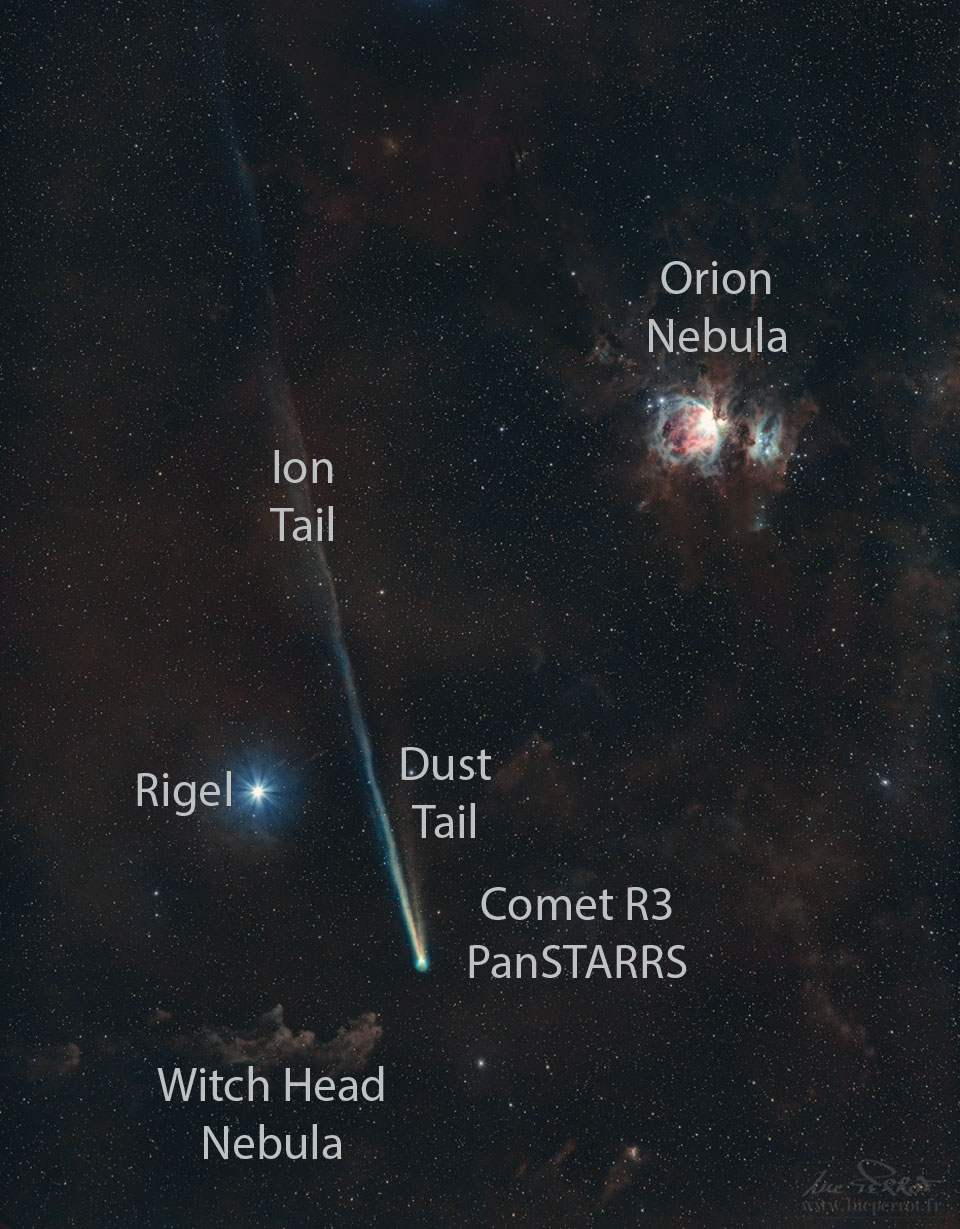
Orion's Dazzling New Sword: Comet PanSTARRS Puts on a Galactic Show

Disclosure: This post contains affiliate links. As an Amazon Associate, I earn from qualifying purchases.

The Full Story

Our cosmic skies are currently graced by a stunning visitor, Comet C/2025 R3 (PanSTARRS), as it embarks on its journey out of the inner solar system. For those with keen eyes and long-exposure cameras, this icy traveler is putting on an unforgettable show, appearing to align perfectly with the familiar constellation Orion the Hunter, as if giving him a brand new, magnificent sword made of starlight. The vibrant Orion Nebula, a stellar nursery much farther away, can also be seen in the same frame, adding to the breathtaking cosmic scenery. What makes Comet R3 PanSTARRS particularly special right now is its spectacular dual-tail display. The first is a distinct, short 'dust tail' that appears to point generally towards the top of the images. This tail is made up of tiny dust and ice particles that the comet sheds as it's warmed by the Sun. These particles are gently pushed away from the Sun by its light pressure, but their larger size means they still carry some of the comet's original momentum, often giving this tail a slight curve. It shines by simply reflecting the Sun's light, much like dust sparkling in a sunbeam. The second, even more striking feature, is its long, wavy 'ion tail,' which streams off dramatically towards the upper left. This tail is formed from gases (like carbon monoxide) that have become electrically charged, or 'ionized,' by the Sun's powerful ultraviolet radiation. Once ionized, these gases are directly pushed away from the Sun by the solar wind โ€“ a constant stream of charged particles flowing from our star โ€“ making the ion tail always point straight away from the Sun. It glows a captivating blue because these excited, charged gases emit light, much like how a neon sign or a fluorescent light tube glows. Capturing these intricate details requires specialized astrophotography techniques. The featured image, for instance, was taken just a few days ago by dedicated sky-watchers from Reunion Island, a French territory nestled in the southern Indian Ocean. This kind of imaging, involving long exposures, allows cameras to gather enough light over time to reveal the faint beauty of distant celestial objects that might be invisible to the naked eye. The clarity of both tails in this image offers scientists a fantastic opportunity to study the comet's composition and how it interacts with the solar environment. Observing these distinct tails provides astronomers with invaluable insights. The composition of the dust and gases in the tails, along with their different reactions to solar radiation and solar wind, gives us clues about the comet's icy core. Since comets are thought to be leftover building blocks from the early solar system, understanding them helps us piece together the conditions present when our planets were forming billions of years ago. Itโ€™s like getting a direct sample of our solar systemโ€™s ancient history. As Comet R3 PanSTARRS continues its journey away from the Sun, it will gradually dim as it heads into the colder, darker reaches of space. However, the photographic legacy of its current dazzling display, as highlighted by initiatives like NASAโ€™s Astronomy Picture of the Day (APOD) and its 'Growing Gallery' tracking its journey into 2026, will continue to inspire and inform. These observations serve as a reminder of the dynamic and ever-changing beauty of our universe, encouraging us to look up and wonder.

Key Takeaways

  • 1 Comet PanSTARRS R3 is currently visible near the Orion constellation, creating a spectacular display with its two distinct tails.
  • 2 The comet features a dust tail (reflecting sunlight) and a long, wavy, blue ion tail (glowing from energized gases), each formed by different interactions with the Sun.
  • 3 Observations of these unique tails provide crucial insights into the comet's composition and the conditions of the early solar system.
  • 4 Astrophotographers use long-exposure cameras to capture the comet's faint beauty, like the recent image taken from Reunion Island.
National Geographic Planisphere Star Finder

National Geographic Planisphere Star Finder

Essential tool for identifying constellations and stars. Perfect for beginners learning the night sky.

Check Price on Amazon
*As an Amazon Associate, we earn from qualifying purchases.

๐Ÿ’ก Think of it this way:

Imagine a cosmic artist painting two distinct strokes across the night sky โ€“ one a shimmering golden trail from reflected sunlight, like dust kicked up on a celestial highway, and the other a ghostly blue glow, much like a giant fluorescent light tube, energized by the Sun's winds.

How We Know This

The breathtaking views of Comet PanSTARRS R3, including the featured image, were captured using specialized long-exposure cameras. These cameras work by keeping their shutters open for an extended period, sometimes for several minutes or even hours, to collect as much light as possible from faint celestial objects. This technique allows them to reveal intricate details of distant comets and nebulae that would be too dim for the human eye or even a standard camera lens to see. The image was taken by astrophotographers from Reunion Island, providing a unique vantage point from the Southern Hemisphere.

What This Means

Studying comets like PanSTARRS R3 helps us piece together the history of our solar system, as they are essentially frozen relics from its formation, preserving material from billions of years ago. Understanding their composition and how their distinct tails react to the Sun's energy provides crucial data on the conditions in the early solar system and the behavior of the solar wind, which impacts everything from space weather to planetary atmospheres. As the comet continues its journey, ongoing observations will provide more insights into its changing appearance and dynamics, potentially revealing new details about its icy core and the farthest reaches of our cosmic neighborhood.

Why It Matters

Comets are like cosmic time capsules, offering precious clues about the early solar system's ingredients and conditions. Witnessing one with such clearly visible and distinct features not only provides scientists with vital data on its composition and behavior but also offers us a rare and breathtaking spectacle in our night sky, connecting us to the vastness of space.

Related Topics

#Comet PanSTARRS #Astronomy #Orion Constellation #Space Photography #Solar System