Back to Articles Image Of The Day

Orion's Grand Appearance: A Rare Celestial Spectacle Over Mount Teide

📖 3 min read 📊 beginner 🏷️ NASA APOD

In Brief

Imagine capturing the stunning Orion constellation in all its glory, revealing hidden cosmic clouds, all while framed by a snow-capped volcano. This rare astronomical photo, taken from the Canary Islands, showcases the universe's beauty and the skill required to reveal it. It's a breathtaking blend of celestial wonder and earthly majesty.
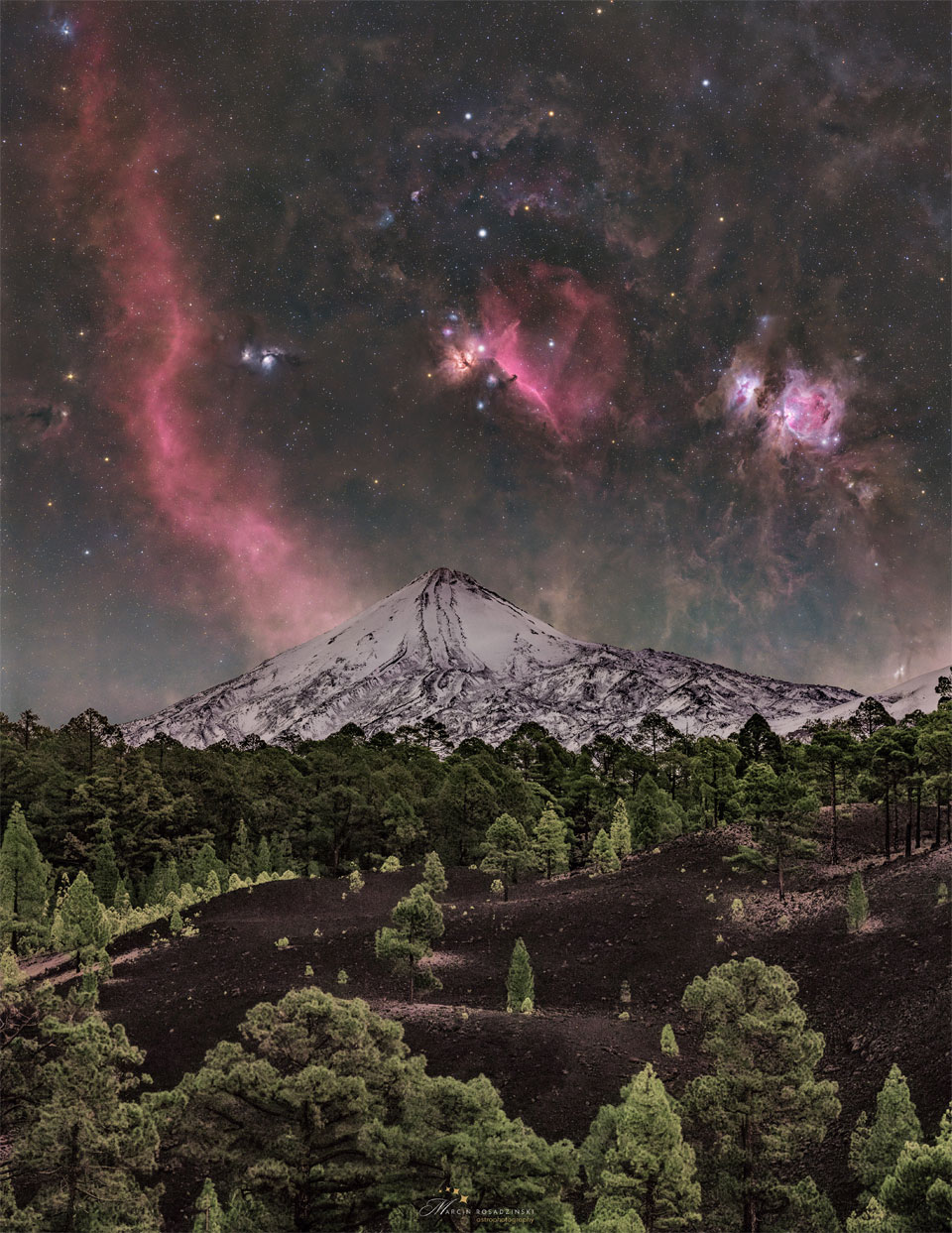
Orion's Grand Appearance: A Rare Celestial Spectacle Over Mount Teide

Disclosure: This post contains affiliate links. As an Amazon Associate, I earn from qualifying purchases.

The Full Story

Imagine peering into the night sky and seeing not just the familiar stars, but also the faint, ghostly clouds of gas and dust where new stars are born. That's exactly what a recent NASA Astronomy Picture of the Day (APOD) image achieved, capturing the majestic Orion constellation in an incredibly unique way: framed by the snow-capped peak of Mount Teide in Spain's Canary Islands. The star of this cosmic show is Orion, often called 'The Hunter,' one of the most recognizable constellations in our winter sky. But this picture reveals so much more than just bright stars. Thanks to specialized techniques, we can see vast, glowing clouds of gas and dust – called nebulas – that are usually too faint for the naked eye. Among them are the vibrant Orion Nebula, a stellar nursery where new stars are being born, the fiery-looking Flame Nebula, and the enormous, subtle arc of Barnard's Loop, a faint but massive structure thought to be the remnant of an ancient supernova. Adding a dramatic earthly anchor to this celestial spectacle is Mount Teide, a towering volcano on the island of Tenerife. Its snow-capped peak provided a striking contrast to the cosmic backdrop, but capturing it in such a state is a rare feat. Snow on Teide typically only lasts for a few days each year, meaning the photographer had to be incredibly well-timed to catch both the wintry landscape and the perfectly positioned constellation. Achieving such a detailed and breathtaking shot requires more than just luck; it demands sophisticated photographic techniques. The image isn't a single snapshot, but rather a carefully crafted combination of many 'long exposure' images. Imagine leaving your camera shutter open for an extended period, allowing it to collect more and more light over time, much like an open bucket slowly gathers raindrops. This technique allowed the camera to gather enough light from the incredibly faint nebulas to reveal their intricate structures and colors, which would otherwise remain invisible to our eyes or standard cameras. The photographer also waited for the precise moment late last year, just after sunset, when Orion appeared to perfectly align behind Teide's summit. This image is a powerful reminder of the hidden beauty constantly unfolding in our universe, often invisible without specialized tools and a keen eye. It beautifully merges astrophotography with landscape photography, showcasing both the stunning geology of our planet and the vast, dynamic cosmos beyond. Such images not only inspire awe but also help us appreciate the delicate dance between light, time, and perspective that allows us to glimpse these incredible wonders.

Key Takeaways

  • 1 A rare and stunning image captures the Orion constellation and its hidden nebulas over a snow-capped volcano.
  • 2 Specialized long-exposure photography was used to reveal faint cosmic structures invisible to the naked eye.
  • 3 The photo is a testament to perfect timing, combining celestial alignment with rare earthly conditions like snow on Mount Teide.
National Geographic Planisphere Star Finder

National Geographic Planisphere Star Finder

Essential tool for identifying constellations and stars. Perfect for beginners learning the night sky.

Check Price on Amazon
*As an Amazon Associate, we earn from qualifying purchases.

💡 Think of it this way:

Think of it like patiently collecting tiny bits of light, much like a bucket slowly filling with raindrops, until a complete and stunning picture of the sky's hidden treasures emerges.

How We Know This

The image was created by taking a series of consecutive, long-duration exposures with the same camera from the same location. This technique involves keeping the camera shutter open for extended periods to collect more light from faint objects, making them visible. The photographer also had to time the shot perfectly to capture Mount Teide with its rare snow cover and Orion positioned directly behind it.

What This Means

Such images inspire amateur astronomers and photographers alike to look up and explore, pushing the boundaries of what's possible with astrophotography. They also serve as powerful tools for public outreach, making complex astronomical phenomena tangible and awe-inspiring, fostering a deeper connection to the cosmos we inhabit.

Why It Matters

This breathtaking image reminds us of the hidden wonders in our night sky and the incredible sights we can witness with the right tools and a bit of patience, inspiring a deeper connection to the cosmos.

Related Topics

#Orion #Astrophotography #Nebula #Mount Teide #Canary Islands