Back to Articles Image Of The Day

Meet Comet R3: Our Solar System's Newest Glowing Visitor

📖 3 min read 📊 beginner 🏷️ NASA APOD

In Brief

A spectacular new comet, C/2025 R3 (PanSTARRS), is currently gracing our inner solar system, showing off an incredible, shimmering blue tail. This celestial visitor offers a rare chance to see a 'dirty snowball' from space shedding its icy skin as it gets closer to the Sun.
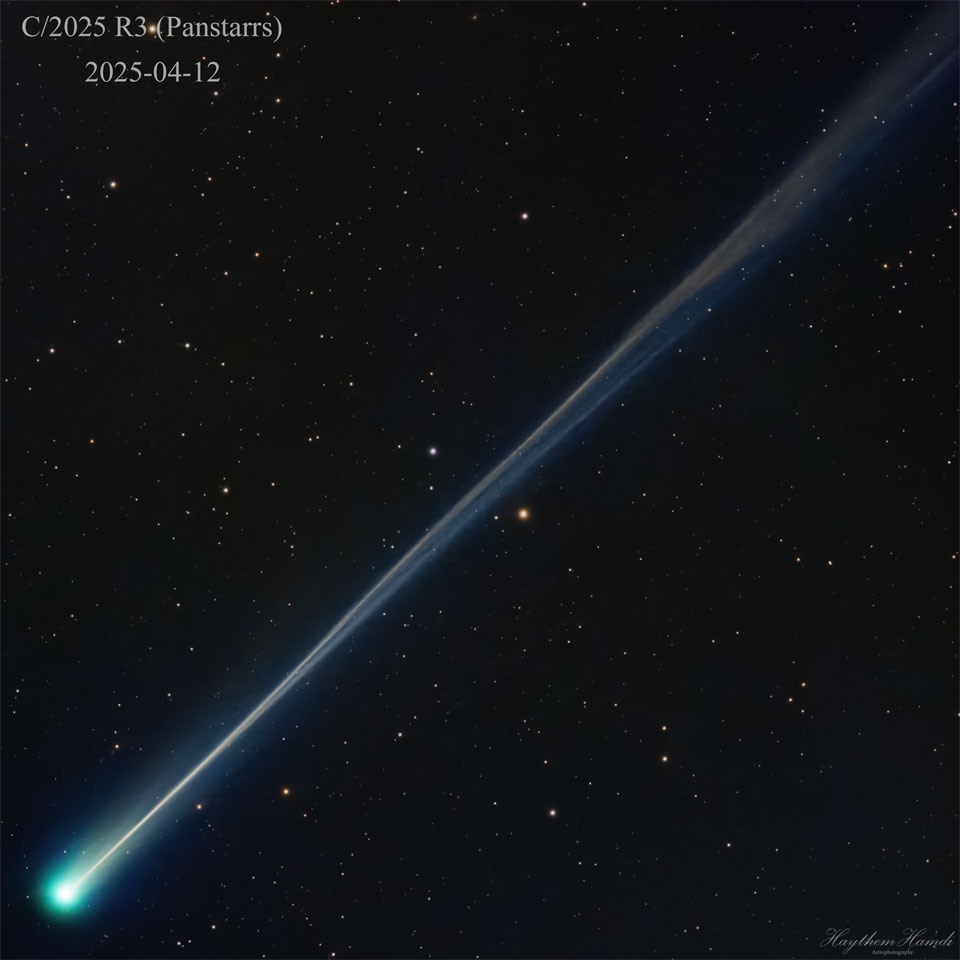
Meet Comet R3: Our Solar System's Newest Glowing Visitor

Disclosure: This post contains affiliate links. As an Amazon Associate, I earn from qualifying purchases.

The Full Story

Our solar system has a new star (or rather, comet) in town! Comet C/2025 R3 (PanSTARRS) has recently entered the inner solar system, quickly becoming a noticeable sight for sky-watchers. While its core, a 'dirty snowball' of ice and rock likely just a few kilometers wide, remains hidden from direct view, its dramatic interaction with the Sun is creating a stunning display. As the comet warms up, it releases gases and dust, forming the impressive tails we can now observe. Comets often boast two distinct tails, and R3 is no exception. First, there's the 'coma,' a fuzzy, cloud-like envelope of neutral gas that surrounds the nucleus, often appearing with a beautiful light green hue. This gas is simply sublimating (turning directly from solid ice to gas) off the comet's icy core. But the most striking feature of Comet R3 is its long, wispy, light blue 'ion tail,' which is the glowing gas we see stretching across the sky. This tail forms when some of the comet's gas gets 'ionized' – meaning powerful sunlight strips electrons from its atoms, giving them an electrical charge. Once charged, these gas particles are no longer just drifting; they become susceptible to the Sun's powerful 'solar wind.' Think of the solar wind as a constant, energetic breeze of charged particles streaming outwards from the Sun. This solar wind acts like a cosmic broom, sweeping the newly ionized gases directly away from the Sun, forming the spectacular blue ion tail. The captivating 'wispy' or wavy appearance of Comet R3’s ion tail is a direct result of the solar wind's ever-changing structure – imagine gusts and lulls, or even magnetic tangles, in this stellar breeze, constantly sculpting the tail as it flows. Recently captured from Rhode Island, USA, the comet showcased an ion tail that stretched for 'many degrees' across the sky – a truly significant sight, often meaning it was visible as a substantial streak, perhaps several fingers wide when held at arm's length. For the next ten days, northern skygazers have the best chance to spot Comet R3 before dawn. After that, its orbital path will shift, making it more easily visible from southern skies. This offers a broad window for observing this exciting new visitor as it continues its journey through our cosmic neighborhood. Observing comets like R3 is like getting a glimpse into the distant past of our solar system. These 'dirty snowballs' are essentially frozen relics, preserved almost unchanged since the birth of our Sun and planets billions of years ago. By studying their composition and how they react to the Sun, scientists can learn more about the raw ingredients that were available when Earth and its neighbors were forming, and potentially even where some of our planet's water might have come from.

Key Takeaways

  • 1 Comet R3 (PanSTARRS) is a new, bright visitor to the inner solar system.
  • 2 It displays two distinct tails: a green gas cloud (coma) and a long, blue, wispy ion tail.
  • 3 The ion tail's wavy appearance is caused by the constantly changing gusts and magnetic fields within the solar wind.
  • 4 Comets like R3 are 'time capsules' offering clues about the early formation of our solar system.
National Geographic Planisphere Star Finder

National Geographic Planisphere Star Finder

Essential tool for identifying constellations and stars. Perfect for beginners learning the night sky.

Check Price on Amazon
*As an Amazon Associate, we earn from qualifying purchases.

💡 Think of it this way:

Imagine a giant, dirty snowball melting as it gets closer to a huge bonfire. As bits of ice and dust boil off, they're not just trailing behind – they're being pushed and sculpted by invisible gusts of wind, creating a beautiful, wavy plume of smoke.

How We Know This

Astronomers, both professional and amateur, captured stunning images of Comet R3 using powerful telescopes and specialized cameras. By carefully observing its path and how its tails react to sunlight and the solar wind, they can gather information about its composition and the space environment it's traveling through. These observations are then shared through platforms like NASA's APOD (Astronomy Picture of the Day) to educate the public.

What This Means

Studying comets like R3 helps us understand the conditions of the early solar system, as they are essentially frozen time capsules of primordial material. Future observations will continue to track R3's journey, providing scientists with more insights into these fascinating cosmic wanderers and potentially revealing more about the building blocks of planets and the origin of water in our solar system. Its continued visibility into 2026 suggests extended opportunities for scientific study.

Why It Matters

Seeing a comet like R3 up close (relatively speaking!) is a special opportunity for anyone to witness the raw beauty of our solar system. It also provides scientists with vital clues about the conditions and materials that existed when our planets first formed billions of years ago.

Related Topics

#Comet #PanSTARRS #Solar System #Astronomy #Space Exploration