Back to Articles Image Of The Day

Rocket Man's First Flight: How 'Nell' Kicked Off Space Exploration

📖 3 min read 📊 beginner 🏷️ NASA APOD

In Brief

Exactly a century ago, Robert H. Goddard launched the world's first liquid-fueled rocket, 'Nell,' marking a pivotal moment in human history. This small, 41-foot hop began our journey to the stars, paving the way for future space travel.
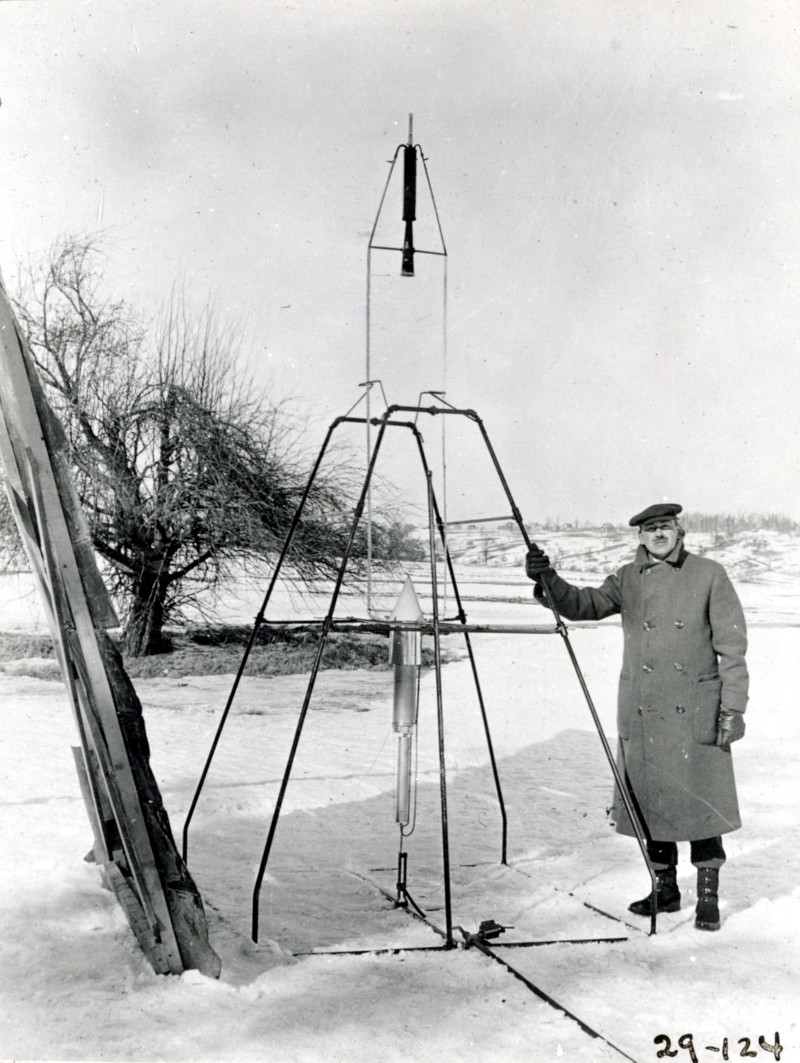
Rocket Man's First Flight: How 'Nell' Kicked Off Space Exploration

Disclosure: This post contains affiliate links. As an Amazon Associate, I earn from qualifying purchases.

The Full Story

Before humans ever set foot on the Moon or launched satellites to beam TV signals across the globe, there was a man with a dream and a small rocket named 'Nell.' Robert H. Goddard, born in Massachusetts in 1882, was just 16 when he devoured H.G. Wells' science fiction classic, 'War Of The Worlds.' That story ignited an ambition in him: to make space travel a reality, not just a fantasy. In an era when rockets were mostly seen as fireworks, Goddard was quietly, diligently working on something truly revolutionary. His groundbreaking moment arrived exactly a century ago, on March 16, 1926. From his aunt Effie's farm in Auburn, Massachusetts – a decidedly low-tech launchpad – Goddard sent 'Nell' skyward. The rocket, just 10 feet tall, ascended to a modest altitude of 41 feet and remained airborne for about 2.5 seconds. While these numbers might seem small compared to today's colossal rockets, this brief flight was a giant leap for mankind, proving that a liquid-fueled rocket could actually work. What made 'Nell' so innovative? Instead of using solid propellants like gunpowder, Goddard's rocket ran on liquid oxygen and gasoline – a much more controllable and powerful fuel source. He also designed it with the heavy motor at the top, a clever trick to achieve stable flight without the need for fins, much like how a dart flies straight because its weight is concentrated at the front. This ingenious engineering was far ahead of its time, demonstrating Goddard's profound understanding of physics and mechanics. Despite being a brilliant experimenter, Goddard's work was often met with skepticism and even ridicule during his lifetime. People struggled to grasp the potential of what he was doing. Yet, his insights were so profound that he was awarded over 200 patents in rocket technology, many of them after his death in 1945. He was, quite simply, an engineering genius whose vision stretched decades into the future. Goddard's legacy is immense. The fundamental principles he developed with 'Nell' and subsequent experiments laid the groundwork for all modern rocketry. Every rocket that has launched into orbit, every satellite sending us GPS signals or weather forecasts, and indeed, the mighty Saturn V rocket that carried humans to the Moon in 1969, owes a direct debt to Robert Goddard. From a small, humble farm in Massachusetts, his dream of space flight took root and eventually blossomed into humanity's incredible journey among the stars.

Key Takeaways

  • 1 Robert H. Goddard launched the world's first liquid-fueled rocket, 'Nell,' in 1926.
  • 2 This short flight proved the viability of liquid propulsion, a crucial step for space travel.
  • 3 Goddard's innovative designs, like placing the motor at the top for stability, were revolutionary.
  • 4 His work, though initially misunderstood, laid the foundational principles for all modern rocketry.
  • 5 Goddard's legacy led directly to technologies like the Moon landing and today's satellites.
LEGO NASA Apollo Saturn V Rocket

LEGO NASA Apollo Saturn V Rocket

Detailed LEGO model of the iconic Saturn V rocket. Perfect for display and space history enthusiasts.

Check Price on Amazon
*As an Amazon Associate, we earn from qualifying purchases.

💡 Think of it this way:

Imagine the Wright brothers' first airplane flight, but for space – a tiny hop that proved a monumental idea could fly, forever changing our perspective on what's possible.

How We Know This

Goddard designed and built 'Nell' himself, combining his deep understanding of physics with hands-on experimentation. He engineered a system where liquid oxygen and gasoline were precisely fed into a motor located at the top of the rocket, generating the controlled thrust needed to lift it off the ground. This experiment was all about proving the core concept: that liquid fuels could power a rocket into the air.

What This Means

Goddard's pioneering work with 'Nell' means that whenever you use GPS to find your way, watch a satellite TV broadcast, or check a weather forecast, you're experiencing his lasting impact. His principles are still fundamental to every space mission today, from launching new satellites to planning future human voyages to Mars and beyond. 'Nell' was the tiny seed from which all of humanity's incredible space exploration has grown.

Why It Matters

This event is the spark that ignited humanity's dream of exploring space, leading to everything from satellite communication and GPS to sending humans to the Moon and Mars. Without Goddard's pioneering work, our modern, connected world might look very different.

Related Topics

#Robert Goddard #Rocketry #Space Exploration #Liquid Fuel Rocket #NASA History