Back to Articles Image Of The Day

Cosmic Dance: Four Galaxies Locked in a Gravitational Embrace

📖 3 min read 📊 beginner 🏷️ NASA APOD

In Brief

Astronomers have captured an incredible image of Hickson 44, a compact group of four galaxies caught in a cosmic dance of gravitational attraction. Located 100 million light-years away, these galaxies are slowly but surely merging, showcasing a fundamental process in the universe.
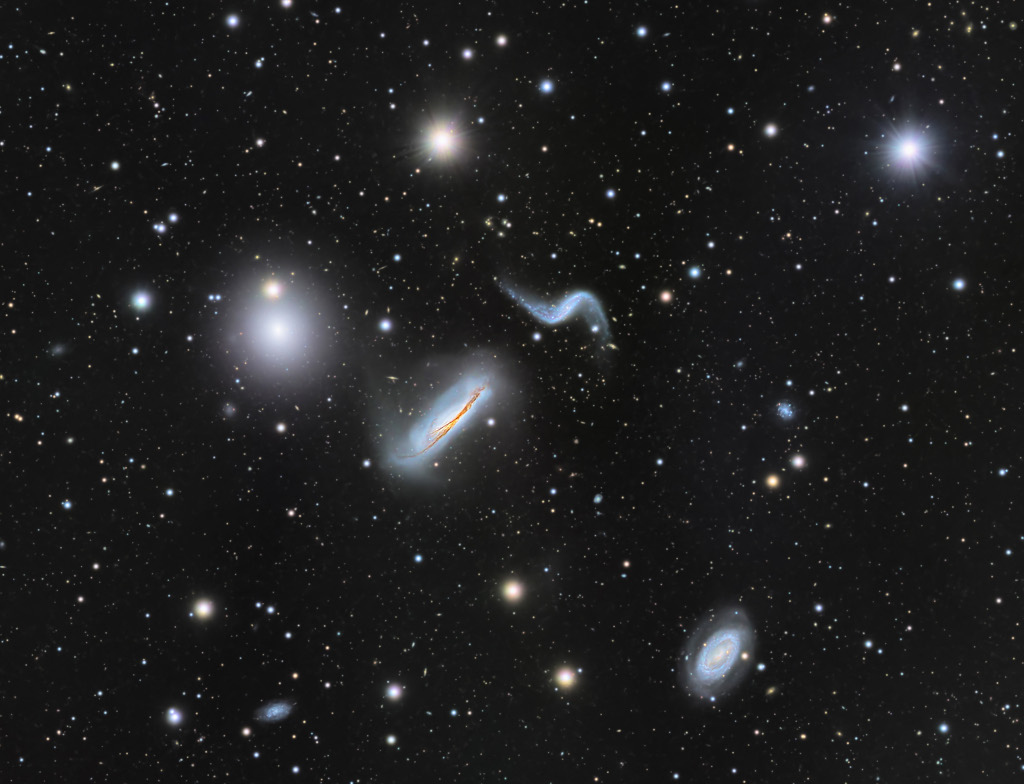
Cosmic Dance: Four Galaxies Locked in a Gravitational Embrace

Disclosure: This post contains affiliate links. As an Amazon Associate, I earn from qualifying purchases.

The Full Story

Deep within the northern springtime constellation Leo, about 100 million light-years from Earth, astronomers have captured an incredible cosmic tableau: Hickson 44. This isn't just one galaxy, but a tightly knit group of four, locked in an intricate gravitational dance. These 'Hickson Compact Groups' were first identified by Canadian astronomer Paul Hickson and his team, who scoured the skies for such close-knit galactic families. Hickson 44 is a prime example of what happens when galaxies get a little too close for comfort, a phenomenon that offers vital clues about the universe's grand evolutionary story. Let's zoom in on the main characters of this cosmic drama. In the center, we see two prominent spiral galaxies. One, NGC 3190, is seen almost perfectly edge-on, revealing mesmerizing, warped lanes of dust that tell tales of past or ongoing gravitational pulls. Its close companion, NGC 3187, is an elegant S-shaped spiral. To the left, the bright, smooth oval of NGC 3193 stands out as an elliptical galaxy. These three, NGC 3190, 3187, and 3193, are also collectively known as Arp 316. Completing the quartet is NGC 3185, another spiral galaxy, tucked away toward the lower right. To give you a sense of scale, the majestic NGC 3190 alone stretches about 75,000 light-years across – roughly three-quarters the size of our own Milky Way! What makes Hickson 44 so fascinating is that these galaxies aren't just peacefully coexisting. Look closely, and you'll see signs of a cosmic struggle. Their shapes are subtly distorted, not perfectly symmetrical as isolated galaxies often appear. More strikingly, astronomers observe enhanced star formation within them. This burst of new stars is like fireworks signaling a dramatic event: the immense gravitational forces pulling and stretching these galaxies are compressing gas and dust, triggering new stellar births. It's a true gravitational 'tug-of-war,' where each galaxy's gravity is pulling on its neighbors, slowly but surely drawing them closer. This slow-motion collision isn't a destructive catastrophe but a normal and crucial part of how galaxies evolve. Over cosmic timescales—billions of years—this gravitational embrace will inevitably lead to a full-blown galaxy merger, where the four will eventually combine into one larger galaxy. Scientists now understand that such mergers are fundamental to galactic growth, transforming smaller, irregular galaxies into the grand spirals and giant ellipticals we see today. Even our own Milky Way is not exempt; we're currently on a collision course with our galactic neighbor, Andromeda, a dance that will culminate in a grand merger billions of years from now. By studying Hickson 44, we're essentially getting a sneak peek at our own galaxy's distant future.

Key Takeaways

  • 1 Hickson 44 is a compact group of four galaxies engaged in a gravitational 'tug-of-war'.
  • 2 These interacting galaxies show signs of distortion and enhanced star formation.
  • 3 Galaxy mergers are a normal and crucial part of galaxy evolution, including for our own Milky Way.
  • 4 Understanding these groups helps us predict the long-term fate and evolution of galaxies across the universe.
Hubble Space Telescope Deep Field Poster

Hubble Space Telescope Deep Field Poster

Stunning poster featuring iconic Hubble Space Telescope imagery. Perfect for space enthusiasts.

Check Price on Amazon
*As an Amazon Associate, we earn from qualifying purchases.

💡 Think of it this way:

Imagine it like a cosmic slow-motion demolition derby, where galaxies are destined to collide and eventually become one, or a group of dancers slowly coming together for a grand finale.

How We Know This

Astronomers use powerful telescopes to peer across vast cosmic distances, capturing images of these distant galaxy groups. By analyzing the light from these galaxies, scientists can determine their distance, study their intricate shapes, and detect the subtle signs of gravitational interaction and active star formation. The distinctive patterns in their light also help identify individual galaxy types and features like warped dust lanes.

What This Means

Studying groups like Hickson 44 helps scientists refine their models of galaxy evolution, providing crucial clues about how galaxies formed billions of years ago and how they might continue to change in the distant future. It also offers insights into the role of gravity and potentially dark matter in shaping the cosmos, guiding future research into the fundamental forces that govern the universe.

Why It Matters

Understanding these cosmic collisions helps us piece together the grand story of how galaxies, including our own Milky Way, grow and evolve over billions of years. It offers a glimpse into the future of our own galaxy.

Related Topics

#Galaxy Mergers #Hickson 44 #Galaxy Evolution #Astronomy #Compact Groups