Back to Articles Image Of The Day

Cosmic Collisions: We've Heard 218 Black Hole & Neutron Star Mergers!

📖 3 min read 📊 beginner 🏷️ NASA APOD

In Brief

Scientists have now 'heard' an incredible 218 gravitational wave signals from violent cosmic collisions between black holes and neutron stars. These ripples in spacetime, first detected in 2015, confirm a century-old prediction by Albert Einstein.
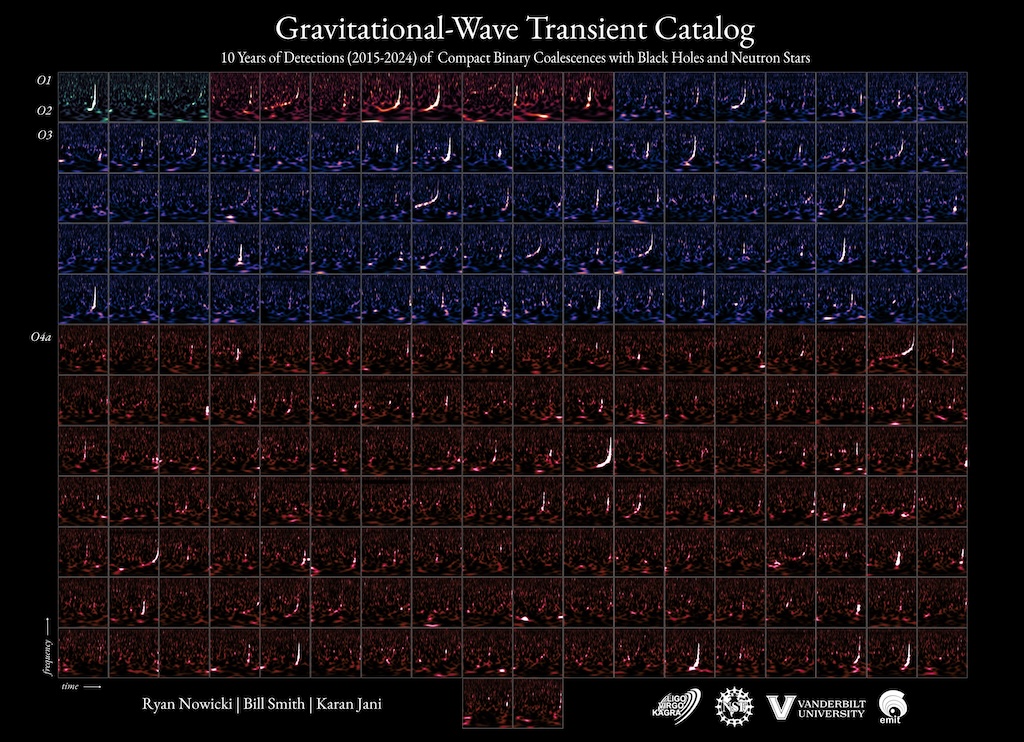
Cosmic Collisions: We've Heard 218 Black Hole & Neutron Star Mergers!

Disclosure: This post contains affiliate links. As an Amazon Associate, I earn from qualifying purchases.

The Full Story

While space is a silent vacuum, it's not entirely quiet to our most advanced 'ears.' Scientists have now cataloged a remarkable 218 cosmic clashes – the violent mergers of black holes and neutron stars – by 'listening' for gravitational waves. Imagine spacetime itself as a giant, flexible fabric. When incredibly massive objects like these dance together and ultimately collide, they create ripples in this fabric, much like dropping a stone into a pond creates waves on the water's surface. These 'ripples,' called gravitational waves, are what scientists detect. As two black holes or neutron stars — incredibly dense remnants of giant stars — spiral closer and closer, they accelerate to incredible speeds. This final, furious dance creates a unique signal known as a 'chirp.' It starts at a low frequency, slowly rising in pitch as the objects orbit faster and faster, until they finally merge in a spectacular cosmic crescendo. This incredible count of 218 mergers comes from a global network of sophisticated detectors, including LIGO, Virgo, and KAGRA. While these events are exceptionally rare in our own Milky Way galaxy, they're happening continuously across the vastness of the cosmos. Interestingly, most of these detections involve two black holes merging, even though neutron stars are thought to be more common in the universe. This isn't because black holes merge more often, but because they're typically much heavier, producing 'louder' gravitational wave signals that can be detected from much farther away. The ability to 'hear' these cosmic events is a monumental achievement, first accomplished in 2015. It was a direct confirmation of a century-old prediction by Albert Einstein, who theorized the existence of gravitational waves in his General Theory of Relativity. For millennia, we've observed the universe using light, essentially 'seeing' it. Now, with gravitational wave astronomy, we've gained an entirely new sense, allowing us to 'feel' the most extreme events in ways light simply cannot reveal.

Key Takeaways

  • 1 Scientists have detected 218 gravitational wave signals from merging black holes and neutron stars.
  • 2 Gravitational waves are 'ripples' in spacetime caused by extreme cosmic events.
  • 3 The detections confirm Albert Einstein's century-old prediction.
  • 4 This new method of 'listening' to the universe offers unprecedented insights into its most violent phenomena.
National Geographic Planisphere Star Finder

National Geographic Planisphere Star Finder

Essential tool for identifying constellations and stars. Perfect for beginners learning the night sky.

Check Price on Amazon
*As an Amazon Associate, we earn from qualifying purchases.

💡 Think of it this way:

Imagine dropping two heavy bowling balls into a giant, cosmic pond and feeling the tiny ripples they create on the water – except these ripples are in the fabric of spacetime, not water!

How We Know This

The 'ears' that detect these faint whispers from space are colossal scientific instruments like the Laser Interferometer Gravitational-Wave Observatory (LIGO) in the U.S., Virgo in Italy, and KAGRA in Japan. These detectors consist of long, L-shaped tunnels with lasers bouncing back and forth. When a gravitational wave passes through Earth, it stretches and squeezes spacetime ever so slightly, creating a minuscule change in the length of these arms. The lasers detect these tiny shifts, allowing scientists to pinpoint when and where a cosmic collision occurred.

What This Means

With more detectors coming online and existing ones becoming even more sensitive, we can expect to 'hear' thousands more of these cosmic crashes in the coming years. Each detection adds a piece to the puzzle of how black holes and neutron stars form, evolve, and interact, shedding light on the life cycles of massive stars and the fundamental forces shaping our universe. This new era of gravitational wave astronomy promises to unveil previously hidden aspects of the cosmos, from the mysteries of dark matter to the very first moments after the Big Bang.

Why It Matters

This discovery gives humanity a brand new way to observe the universe's most extreme events, helping us understand the fundamental forces that shape galaxies and the very fabric of spacetime itself.

Related Topics

#Gravitational Waves #Black Holes #Neutron Stars #LIGO #Astrophysics